
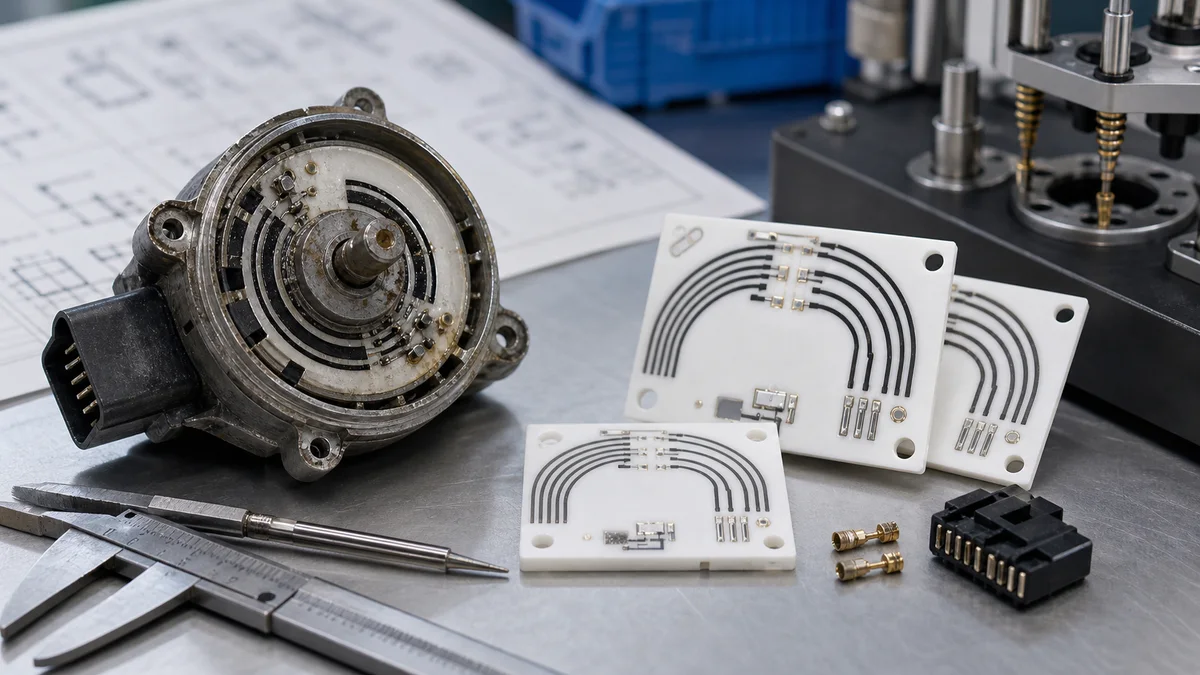
Many industrial and automotive assemblies remain in service after the original potentiometer, angle sensor, fuel level sensor, or position feedback part becomes difficult to purchase. A custom thick film circuit can sometimes replace the internal resistive element or sensor PCB when the mechanical housing and electrical output can be defined.
What must be matched?
- Mechanical outline, mounting holes, shaft or lever movement, and connector position.
- Total resistance, output curve, tolerance, and usable electrical angle or stroke.
- Terminal arrangement and contact/wiper path.
- Operating temperature, vibration, humidity, fuel/oil exposure, and expected life.
- Assembly method inside the original housing.
From sample to replacement drawing
The development process usually starts with sample photos, dimensions, and electrical measurements. Engineers then convert the legacy geometry into a manufacturable ceramic or film substrate drawing, define the printed resistor and silver terminal overlap, and validate the output curve with trial samples.
Where thick film helps
Thick film technology is useful when the replacement part needs a custom arc resistor, compact ceramic circuit, printed silver terminal system, stable fired conductor pattern, or application-specific resistance curve. It can also support small-batch validation before larger replacement production.
Information to send
Send the old part number if available, clear photos, measured dimensions, resistance readings at several positions, connector pinout, operating environment, and target quantity. If the old part is damaged, send both the failed sample and any equipment-side requirements.