
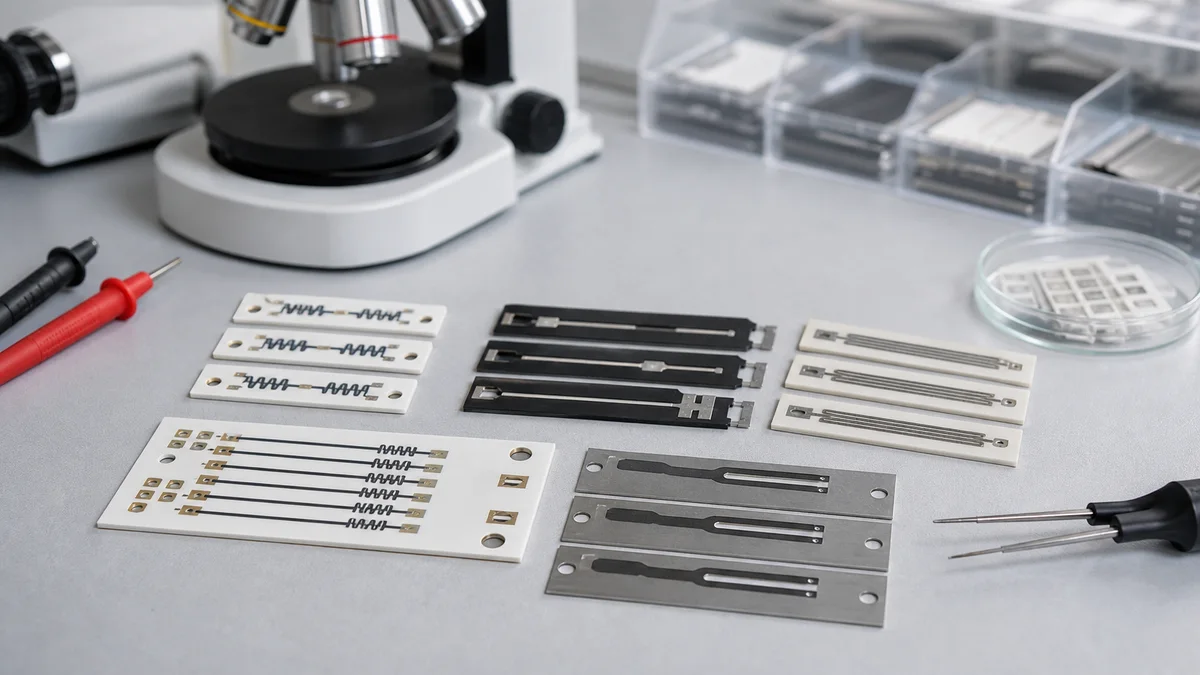
Resistive elements can be made using several material systems. Buyers often compare carbon film, conductive plastic, cermet, and thick film ceramic circuits when replacing a legacy sensor or developing a new feedback product. The right choice depends on life, linearity, cost, temperature, substrate, contact system, and production volume.
| Material path | Typical advantage | Review point |
|---|---|---|
| Carbon film | Cost-effective for many contact-type resistive elements. | Confirm wear life, noise, humidity stability, and contact compatibility. |
| Conductive plastic | Useful for long-life contact applications and smooth output. | Material and forming route can affect cost, diameter, and temperature limits. |
| Cermet | Good stability for many precision trimmer and resistor applications. | Review contact behavior, adjustment mode, and mechanical integration. |
| Thick film ceramic | Strong fit for fired resistor tracks, sensor circuits, heaters, and compact ceramic modules. | Substrate, paste system, silver termination, trimming need, and environment must be matched. |
When thick film ceramic is worth evaluating
- The product needs a fired resistor or conductor pattern on a stable ceramic base.
- The application has high temperature, fuel/oil exposure, or thermal cycling requirements.
- The circuit shape is custom: arc, semicircle, strip, slot, or compact module.
- The design needs stable silver terminals, collector tracks, or custom resistance curves.
Do not select by material name alone
Two parts described with the same material name may perform differently because of substrate, paste chemistry, firing process, geometry, contact system, and encapsulation. A proper review should compare the full stack and the application environment.