
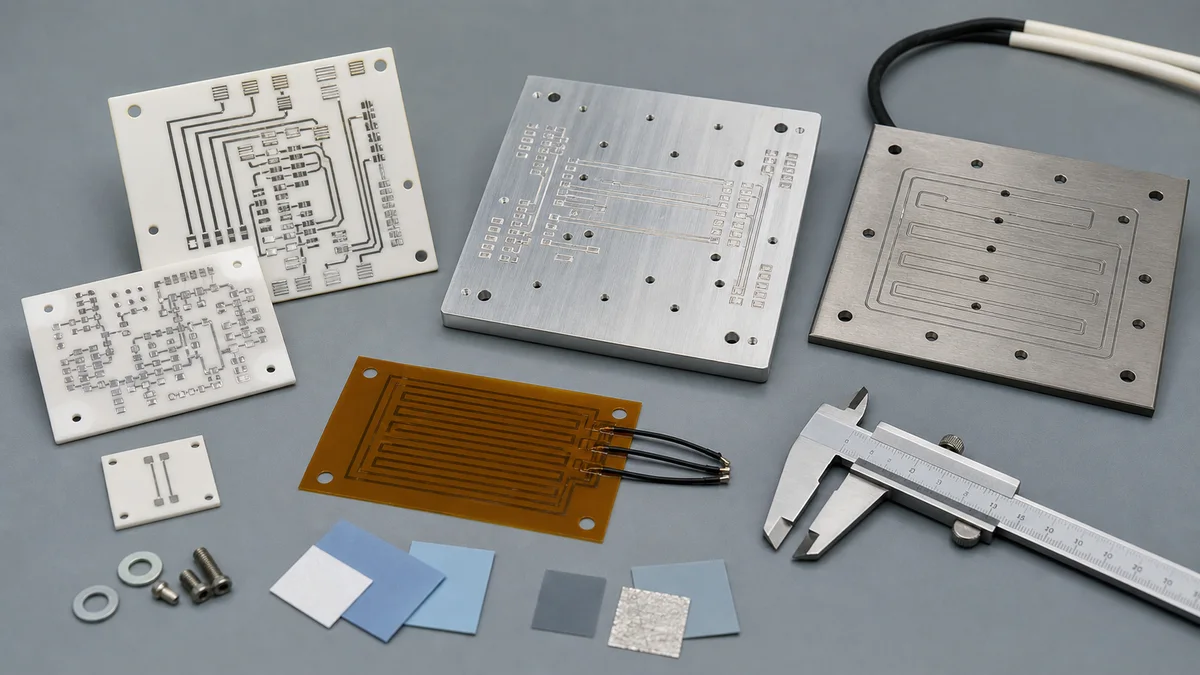
The substrate is the mechanical base, electrical insulator, and thermal path for a thick film circuit. Choosing the substrate early prevents problems in resistance stability, heat dissipation, adhesion, assembly, and cost.
Alumina substrate
Alumina is the most common ceramic substrate for thick film circuits. It offers good insulation, stable processing, mechanical strength, and cost-effective production. It is widely used for sensor circuits, resistor networks, fuel gauge circuits, and ceramic thick film boards.
Aluminum nitride substrate
AlN is selected when thermal conductivity is the main design driver. It is useful for power electronics, high heat flux modules, and compact circuits where heat must move quickly from active or resistive elements.
Stainless steel substrate
Stainless steel is common in thick film heating elements because it provides mechanical strength, fast heating response, and compatibility with appliance or industrial heater structures when paired with suitable insulating layers.
Aluminum substrate
Aluminum can be used for heater plates and thermal products where low weight and heat spreading matter. The dielectric insulation system must be matched to voltage and temperature requirements.
Flexible PI substrate
PI flexible thick film resistors are used where the circuit must bend or fit a compact surface. They are not direct substitutes for ceramic high-temperature circuits, but they solve different mechanical integration problems.
Selection criteria
- Operating temperature and thermal cycling.
- Power density and heat dissipation path.
- Electrical insulation and voltage clearance.
- Mechanical shape, mounting, and vibration.
- Production volume and cost target.