
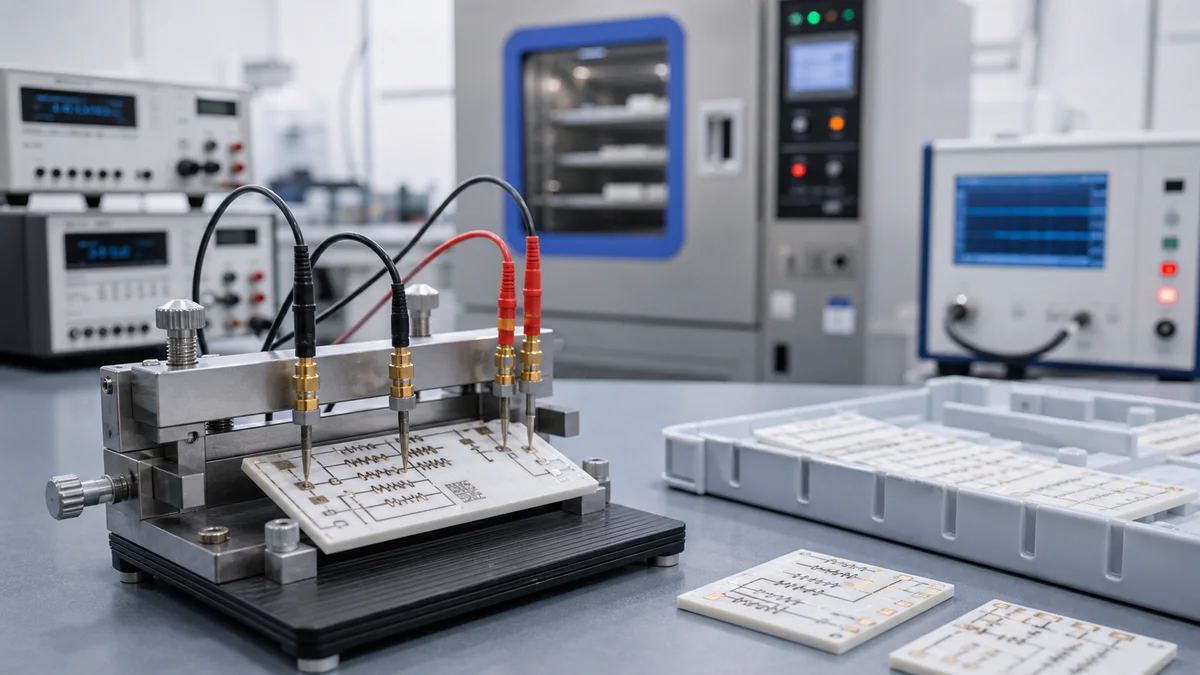
Thick film circuit reliability is not a single material property. It is the result of substrate selection, paste compatibility, firing profile, layout, assembly, sealing, environmental exposure, and test strategy.
Silver migration
Silver-containing conductors are widely used but can be vulnerable to migration under humidity and electrical bias. The result may be leakage, insulation resistance reduction, or short circuit. Spacing, conductor system, dielectric coverage, surface cleanliness, and encapsulation all matter.
Resistor drift
Drift can come from paste instability, firing variation, trimming damage, power loading, moisture, or thermal aging. Designs with tight tolerance should verify both initial accuracy and post-stress change.
Adhesion and cracking
Adhesion depends on substrate surface, paste chemistry, glass phase, firing profile, and thermal expansion match. Thermal cycling can expose weak interfaces or stacked-film stress.
Dielectric breakdown
Dielectric layers need adequate thickness, coverage, and absence of pinholes. Crossover structures and high-voltage spacing should be reviewed carefully.
Wire bond and solder joint reliability
Hybrid circuits may include soldered components, die attach, and wire bonds. Metallization choice, surface finish, cleanliness, bond material, and thermal exposure influence reliability.
Recommended verification
- Visual inspection and dimension check.
- Resistance and functional electrical test.
- Insulation resistance and dielectric withstand when relevant.
- Adhesion or pull testing for critical conductor pads.
- Thermal cycling, humidity bias, aging, and power load tests for high-reliability projects.