
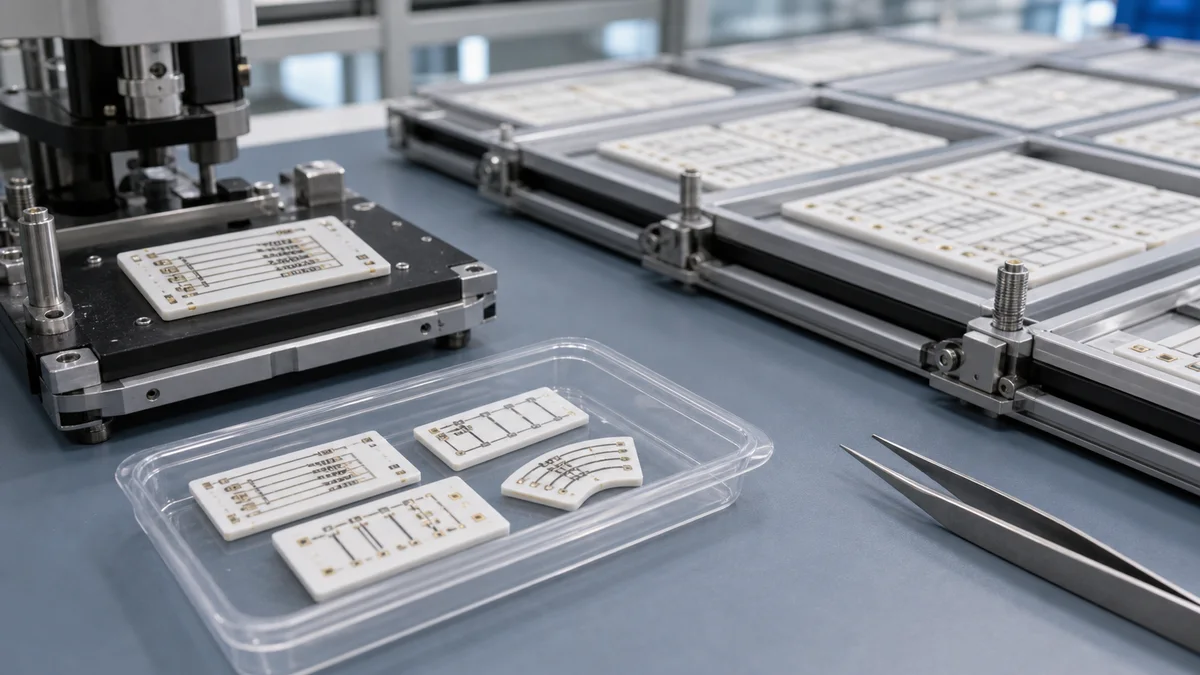
Prototype to Production for Thick Film Projects explains prototype to production for buyers and engineers evaluating thick film, thin film, and ceramic substrate projects. The goal is to make the RFQ clearer before tooling, samples, or repeat production are planned.
Engineering background
The practical principle is transition from sample validation to repeat production. In ceramic circuit manufacturing, this topic must be considered together with substrate material, metallization, resistor or conductor system, thermal exposure, and inspection method.
Key design checks
- Screen control
- Fixtures
- Inspection plan
- Traceability
Common risks
If prototype to production is ignored, the project can show pilot success but batch variation. These failures may appear during printing, firing, trimming, soldering, assembly, humidity exposure, or thermal cycling, depending on the product.
How to specify it in an RFQ
- State the target electrical function and the acceptable tolerance or output window.
- Include material, substrate thickness, finished size, holes, slots, terminals, and mounting constraints.
- Define the operating temperature, humidity, voltage, current, power, media exposure, and expected life.
- Ask for process feasibility before fixing layout dimensions that may be incompatible with the selected route.
- For precision or high-reliability work, specify the measurement method and any qualification test.
Practical selection guidance
Thick film is usually attractive for printed resistors, heaters, robust ceramic hybrids, and cost-effective custom circuits. Thin film is usually considered when fine geometry, low TCR, ratio matching, RF behavior, or very smooth substrate surfaces dominate. AlN is considered when thermal conductivity and CTE match matter, while alumina remains a common balanced ceramic substrate.
Related reading
- Thick Film PCB manufacturing
- Ceramic thick film circuit
- Alumina thick film PCB
- AlN thick film PCB
- Printed thick film resistor
- Thick film manufacturing process
Important limitation
The values and process choices for a real part are project-dependent. Final capability should be confirmed with the drawing, substrate, film system, and test conditions rather than assumed from a general guide.