
On this page
A nominal resistance increase after one via opens is not enough to establish detection. Variation in the surviving branches, common access paths and the measurement can make the intact and faulty reading ranges overlap. For an already defined parallel bank, calculate those ranges before selecting a decision threshold. The useful output is a separation margin, or a demonstrated ambiguity that the current access and measurement cannot resolve.
Measurement purpose
Determine whether intact and specified single-open resistance intervals remain separated for a fixed via bank under independently justified nuisance bounds.
Specimens and conditions
- Connectivity definition
- Provide both-face net connections, common lands, branches and any attached alternate return paths.
- Measurement state
- Control temperature and low-stress excitation, preserving the as-found fixture and specimen identity.
- Challenge structures
- Use authorized surrogate networks or development coupons with independently known branch states.
Equipment and records required
- Resistance and voltage acquisition: Provide a justified measurement-error bound and range adequate to assess the minimum interval separation.
- Node access fixture: Locate force and sense contacts reproducibly and include the common access contribution inside its actual measurement boundary.
Method sequence
- Bound
Calculate intact and single-open intervals using justified branch, access and measurement bounds.
Record: Network, nuisance bounds and fault-signature intervals.
- Challenge
Exercise adverse intact and fault conditions on approved structures and investigate readings outside the predicted intervals.
Record: Interval-edge challenges and model discrepancies.
- Decide
Calculate the minimum separation margin and preserve unresolved overlapping classes.
Record: Separation margin, supported threshold range or ambiguity statement.
Decision and uncertainty
Claim complete separation only for the specified fault classes whose justified measured-resistance intervals do not overlap; do not infer the identity of a failed hole.
Nominal subtraction does not remove access variation. Deterministic interval separation does not establish a statistical detection probability.
The product drawing owner specifies required fault classes; the test engineer justifies the measurement bounds and supported classification.
Traceable outputs
| Record | Required contents |
|---|---|
| Signature-separation calculation | Fixed network, intact and fault intervals, nuisance bounds, minimum margin and any unresolved overlap. |
| Qualified classification boundary | Specimen topology, contacts, stimulus, challenge evidence and exact permitted fault-class statement. |
Method review decisions
- Treat group continuity and individual-branch integrity as different claims.
- Require separation of intact and specified fault intervals, not merely different nominal values.
- Verify the interval boundaries on controlled structures without damaging saleable circuits.
Draw the network seen by the test terminals
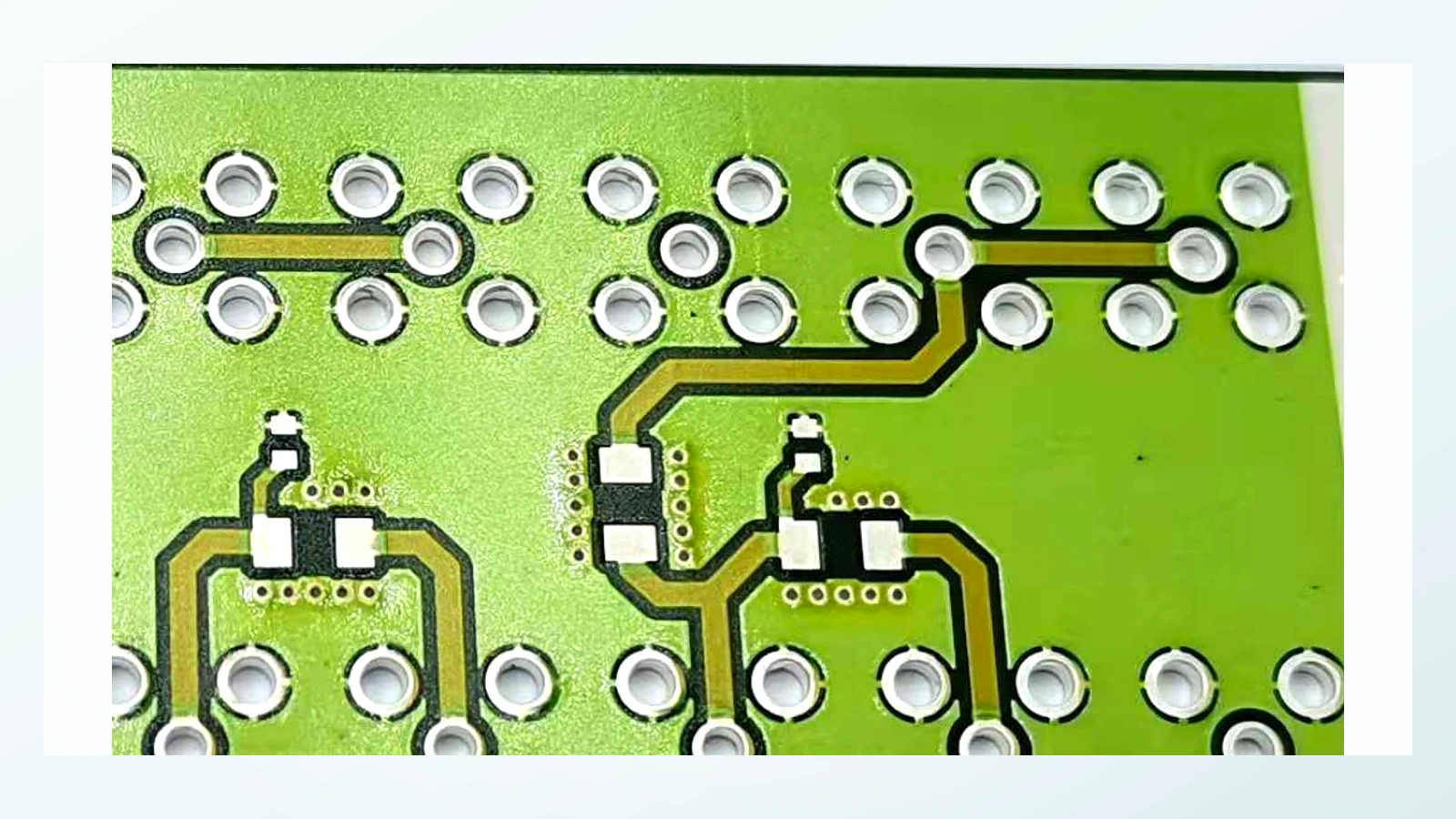
Identify the two faces, common lands, connecting traces and every available force or sense point. A via that looks separate in a photograph may be connected to its neighbor by both face lands. Probing the top and bottom of one hole then still measures the entire parallel bank. Mark electrical node identity rather than equating physical proximity with isolation.
Include external connections that create alternate routes through components, shields or another circuit face. Disconnect them only under an approved procedure that preserves the intended specimen. The diagnostic boundary must correspond to the actual test configuration, not to a simplified artwork layer that omits the return path.
Calculate how much one open changes the group
For N equal independent ohmic branches of resistance r, the ideal equivalent is r divided by N. Removing one branch changes it to r divided by (N − 1). The relative increase is one divided by (N − 1). As the bank gets larger, a single open produces a smaller group-level change even though that branch has lost all continuity.
For a hypothetical eight-branch bank with 40 milliohms per branch, the equivalent rises from 5.000 to 5.714 milliohms after one open, about 14.29 percent. An assumed 12 milliohm common access contribution makes the measured totals 17.000 and 17.714 milliohms, only a 4.20 percent change. These are network examples, not product resistance limits.
Rhealthy = r/N; Rone-open = r/(N−1); relative group change = 1/(N−1)
- N is the number of initially conducting equal branches, greater than one.
- r is each branch resistance at the stated temperature.
- Common access resistance is added outside the ideal parallel group.
Equal ohmic branches with unchanged surviving paths. Unequal branches and distributed face lands require the actual network equations.
Test the weakest electrical signature, not only the symmetric case
If branch resistances differ, the loss of a high-resistance branch removes less conductance than the loss of a low-resistance branch. The same number of open vias can therefore produce different readings. Solve each credible single-open case using measured or bounded branch values, while maintaining the same source and sensing boundary.
Do not use the nominal group resistance alone to reconstruct all branch resistances. One scalar observation cannot identify several unknown paths. A stable total may also conceal compensating changes, such as one branch becoming worse while a contact elsewhere becomes better. The detection claim must survive these nuisance variations or be reduced to a narrower group-level statement.
Expand each fault signature by the nuisance bounds
Assume, for this calculation only, that every conducting branch lies between 39 and 41 milliohms, and that the measurement error is bounded by plus or minus 0.1 milliohm. The eight-path intact equivalent lies between 39/8 and 41/8 milliohms. Any single-open case leaves seven conducting paths, bounded by 39/7 and 41/7. Monotonicity of parallel conductance makes these conservative bounds valid even when the individual branches are unequal within that interval.
Expanding by measurement error gives an intact reading interval of 4.775 to 5.225 milliohms and a single-open interval of approximately 5.4714 to 5.9571 milliohms. The separation margin is the lowest faulty reading minus the highest intact reading, approximately 0.2464 milliohm. A threshold strictly between 5.225 and 5.4714 would separate these two classes under the stated model. This is a hypothetical bound demonstration, not a product acceptance limit.
M = Lfault − Uintact; complete interval separation requires M > 0
- Uintact is the upper bound of the intact measured-resistance interval.
- Lfault is the lower bound across every specified single-open measured-resistance interval.
- M is the separation margin in the same resistance unit.
All declared nuisance bounds apply to the tested state. Intervals are conservative deterministic model bounds, not confidence intervals or claims of a particular statistical coverage.
Show when common access destroys the separation
Now include a common access contribution bounded by 11.5 to 12.5 milliohms, with the same branch and measurement bounds. The intact reading interval becomes 16.275 to 17.725 milliohms. The single-open interval becomes approximately 16.9714 to 18.4571 milliohms. Their overlap means no single upper-threshold rule can classify every permitted intact and faulty state correctly. Different nominal readings did not provide enough separation.
Subtracting a nominal 12 milliohms from every result does not remove its half-milliohm uncertainty. Excluding that contribution with a physically valid four-terminal boundary can help, but residual land resistance and sense-placement variation still require their own bounds. Repeating a measurement on the same two equipotential lands does not identify which branch opened.
| Measurement boundary | Intact interval, milliohms | Single-open interval, milliohms | Separation decision |
|---|---|---|---|
| Bank only; error bounded by ±0.1 milliohm | 4.775 to 5.225 | 5.4714 to 5.9571 | Positive margin: approximately 0.2464 milliohm |
| Bank plus access of 12 ±0.5 milliohms | 16.275 to 17.725 | 16.9714 to 18.4571 | Overlapping intervals: no guaranteed separating threshold |
| Nominal access subtracted from the preceding result | 4.275 to 5.725 | 4.9714 to 6.4571 | Same overlap; a nominal subtraction adds no information |
Challenge the interval edges without altering customer parts
Use a safe surrogate network or purpose-built development coupon with independently known disconnectable branches. Challenge the largest intact reading and the smallest faulty reading, not only a nominal healthy sample and an obvious complete bank open. Include adverse access and measurement states within the proposed model. Test multiple branch locations when distributed lands make their contributions different.
A positive calculated margin requires evidence for the input bounds; assuming narrow ranges until they separate is circular. If a measured challenge falls outside its predicted interval, reopen the network, temperature, access and measurement model. A resistor surrogate establishes electrical logic, not every ceramic failure mechanism. Never cut, drill or overload a customer's circuit for a convenient demonstration; destructive work needs separately authorized specimens.
Keep localization separate from physical cause
A group-resistance increase consistent with one open is not proof that a particular via is cracked. Probe movement, changed face contact, temperature or several partial changes can produce a similar result. Reseat the fixture under controlled conditions and compare independent observations before selecting a physical-analysis location.
When a local branch is implicated, retain its hole coordinate, both-face images and electrical state before sectioning or cleaning. A section through a neighboring hole is not confirmation of the electrical diagnosis. If the available geometry leaves the fault unobservable, report that limitation and choose a development action rather than declaring every hole good.
Release the separation margin and its supported fault class
The final test definition records the fixed network, branch intervals, access bounds, measurement-error treatment, worst fault interval and separation margin. State whether a valid threshold exists and preserve ambiguous readings. An interval-overlap finding means this model cannot guarantee separation; it does not prove that every actual specimen is untestable. Additional independently justified information may narrow the applicable intervals.
A separated single-open class still does not locate the particular hole, prove every partial-degradation case, or establish lifetime. Statistical detection probabilities require a justified probability model rather than reinterpretation of these deterministic intervals. Recalculate after any change to branch population, access, temperature or measurement boundary, keeping architectural via selection with its existing design owner.
Send the via-bank net and test access
Branch detection requires the connected network, not just a hole-count drawing.
- Both-face artwork, via coordinates and all commoning features.
- Available force/sense contacts and attached circuitry.
- Required fault classes and existing raw resistance measurements.
- Approved development coupons and permitted investigation methods.
The drawing-upload form loads as you reach this section.