
On this page
Prepared by Chipsimple Engineering Team, Engineering and technical content review
Published online August 8, 2026 · Reviewed August 8, 2026
Scope: A printed resistor card is one component of a sensor assembly. This guide does not claim compliance with a vehicle, fuel system, or functional-safety requirement. The OEM or system owner defines the mounting location, media, electrical interface, diagnostic strategy, and qualification plan.
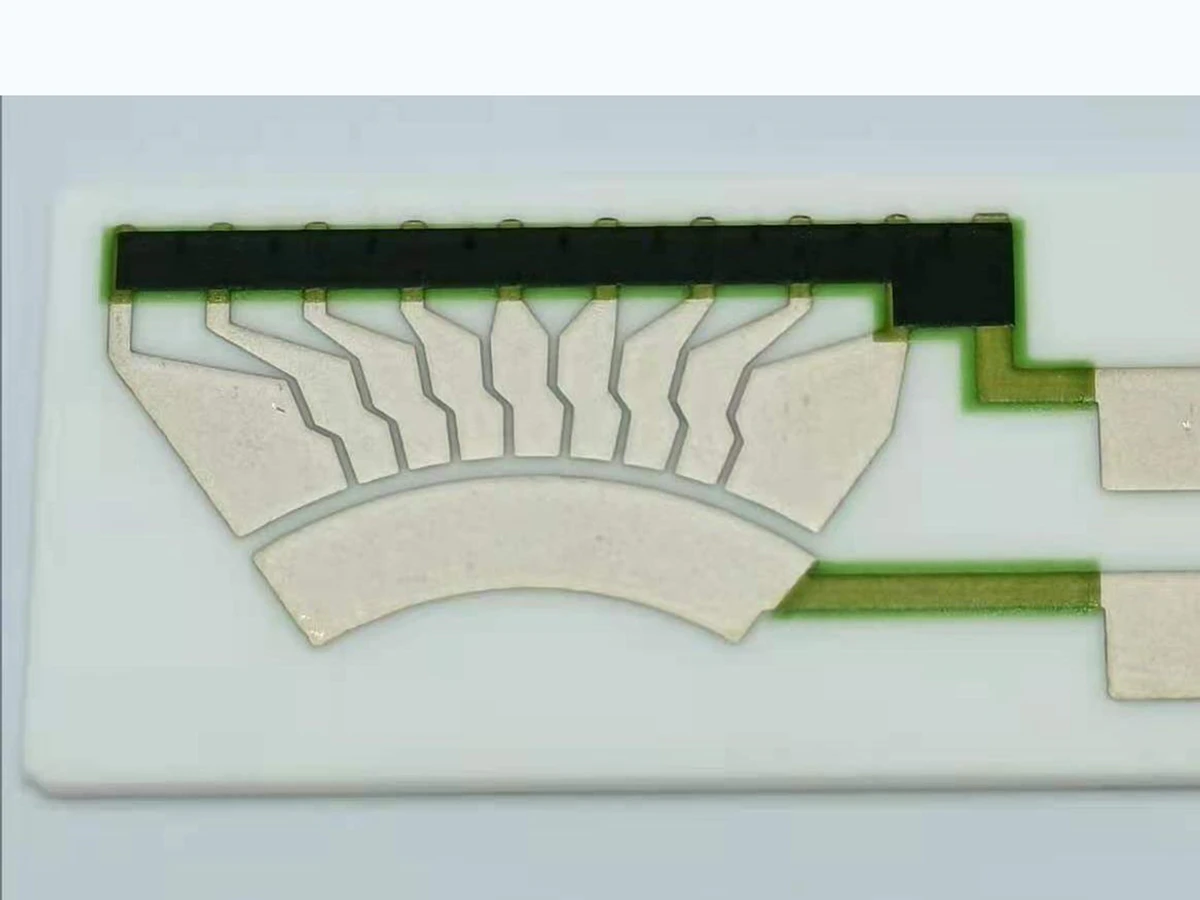
A fuel-level or position-sensor resistor card converts mechanical travel into an electrical signal through a printed resistive track, conductive segments, and moving contact. The visible ceramic pattern is only part of the measurement chain. Float geometry, arm length, pivot position, wiper force, contact material, connector resistance, supply and readout circuit, damping software, and installation angle influence final system output.
Begin with the required transfer function
The starting document is a table or curve relating mechanical position to electrical output. The input may be angle, linear travel, float height, or calibration points. The output may be total resistance, resistance to a reference terminal, voltage under a defined circuit, or another quantity. End points, direction, allowable deviation, dead zones, hysteresis, and non-linear segments must be stated.
A printed-arc drawing without the mechanical datum is incomplete. Define pivot center, active angle, wiper centerline, travel direction, first and last valid contact points, terminal assignment, and areas the contact must not enter. If discrete conductor fingers lie over a continuous resistor, their count and pitch influence resolution and contact behavior. Those choices are coordinated with filtering and display logic.
The wiper interface is electrical and mechanical
Contact resistance and wear are influenced by wiper material, surface finish, normal force, contact geometry, number of points, sliding speed, contamination, vibration, and the printed surface. More force is not automatically better: it may reduce intermittent contact in one condition while increasing wear or substrate stress in another. The spring system and card support are reviewed together.
Current through the contact must also be defined. A sensor card is normally read at low load, but actual excitation and diagnostics come from the customer circuit. Excess current can create local heating or accelerate damage. The acceptance method should state measurement voltage or current, instrument impedance, settling time, scan direction, and reference temperature.
Fluid exposure needs a named test medium
Fuel systems may encounter different fuels, blends, additives, contaminants, water, vapour, and temperature histories. A test fluid is selected by the system owner and documented with concentration, temperature, duration, agitation or cycling, preconditioning, and post-exposure measurements. IEC 60068-2-74 provides a standardized fluid-contamination framework, but it does not choose the correct fluid or severity for every product.
Compatibility includes the ceramic, conductor, resistor, overglaze, terminals, adhesives, seals, carrier, wiper, and connector. A card that remains stable in a coupon test may still fail at assembly level if fluid reaches a joint or alignment changes after conditioning.
Environmental tests follow the mounting location
ISO 16750-1 describes a general approach for environmental conditions and testing of vehicle electrical and electronic equipment by mounting location. It is not one pass/fail test for every component. Temperature profile, mechanical load, electrical load, fluid exposure, and sequence should be tailored to installation. The component drawing should reference the applicable customer specification and revision where one exists.
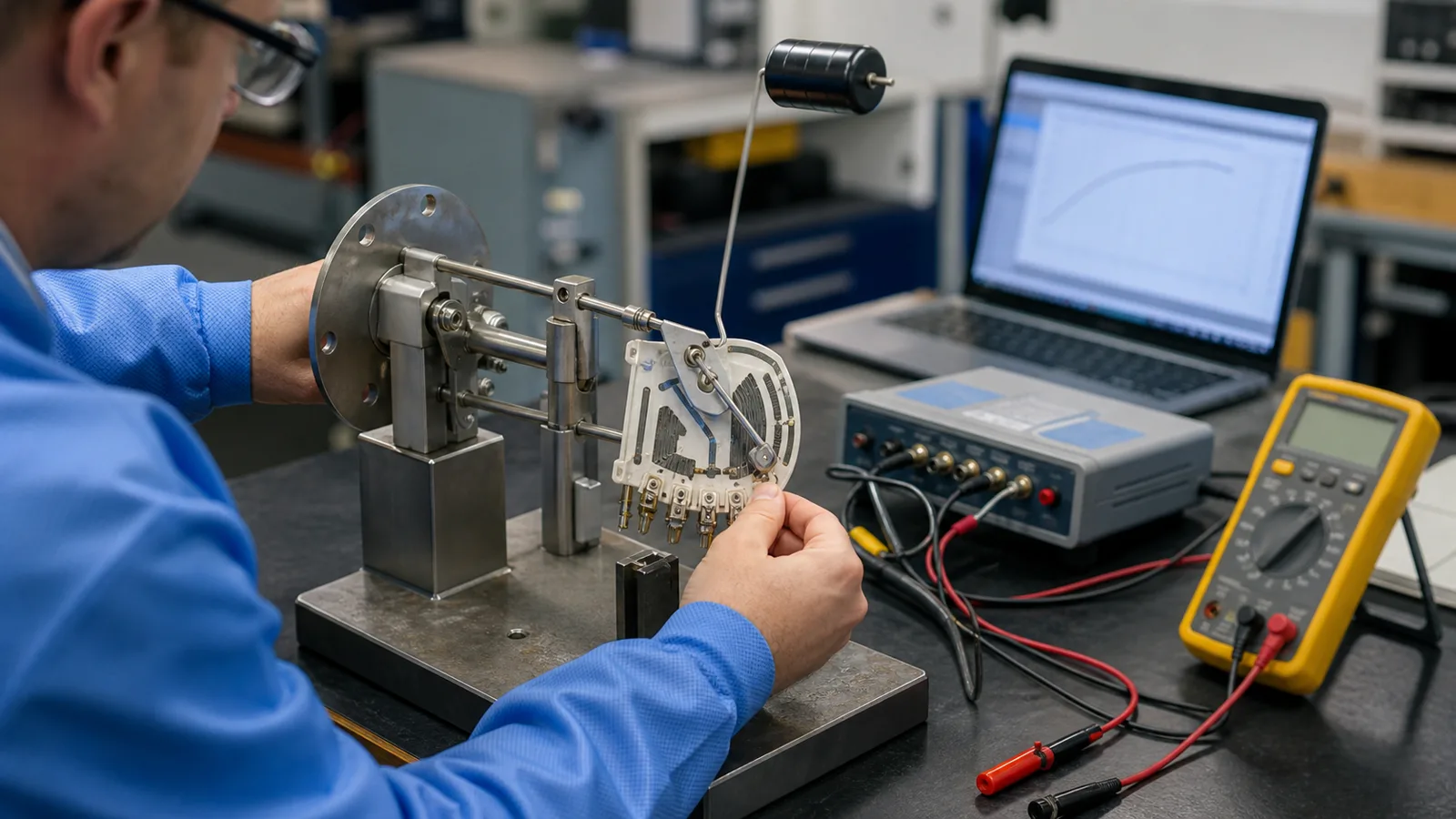
A practical sequence can include baseline visual and dimensional inspection, resistance-curve measurement, temperature conditioning, fluid exposure, vibration or mechanical cycling, repeated curve measurement, and final inspection. Test order matters because combined stresses can expose issues that isolated checks miss. Sample size, failure definition, uncertainty, and treatment of intermittent events should be agreed before testing.
Prototype and production controls
- Measure resistor value or curve before assembly using a defined fixture and reference temperature.
- Verify registration, terminals, active-track geometry, edge quality, contamination, and protective coverage.
- Control card position relative to pivot and wiper path with an assembly fixture.
- Record forward and reverse travel where hysteresis or intermittent contact is a risk.
- Define lot identification and retain the drawing, material system, key process records, and required inspection result.
- Revalidate changes to card, wiper, spring force, carrier, connector, filtering, or installation geometry.
RFQ package for a meaningful review
Provide card outline and thickness, pivot and travel datums, resistance-versus-position table, tolerance, reference temperature, terminal assignment, measurement circuit, wiper details, media and temperature range, mechanical life target, vibration conditions, assembly drawing, quantity, and required reports. If replacing an existing part, measured samples and system data are useful, but the new design still needs an approved specification rather than a visual copy.
The engineering boundary is clear: the card can be manufactured and measured as a component, while system accuracy and durability depend on the complete sensor. Keeping those responsibilities explicit prevents unsupported assumptions.
Primary references
- ISO 16750-1:2023, Road vehicles — Environmental conditions and testing — Part 1 — mounting-location-based environmental-stress framework.
- IEC 60068-2-74:1999, Test Xc: Fluid contamination — standardized fluid-contamination procedure.
- IEC 60068-2-6:2007, Test Fc: Vibration (sinusoidal) — vibration-test and reporting framework.
Review the card and sensor as one system
Send the curve, travel datums, wiper and carrier drawing, electrical interface, media, environment, validation plan, and quantity.