
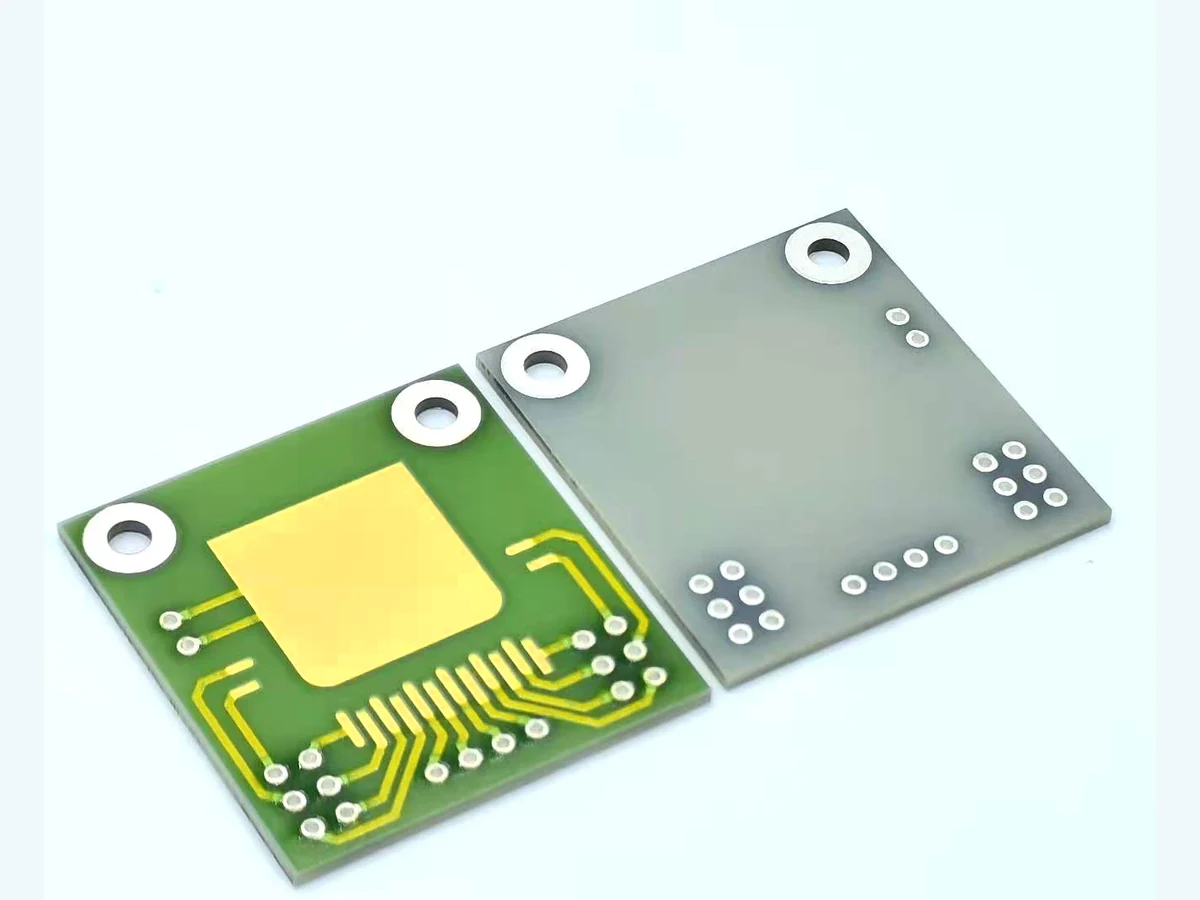
On this page
Prepared by Chipsimple Engineering Team, Engineering and technical content review
Published online August 8, 2026 · Reviewed August 8, 2026
Scope: Alumina and aluminum nitride are families of engineered ceramics, not single fixed-property materials. Values vary by purity, additives, porosity, surface finish, thickness, supplier, and test method. Use the released supplier data sheet for calculations and qualification.
The substrate question in a ceramic thick film project is often framed too simply: which material has better thermal conductivity? Aluminum nitride generally offers substantially higher thermal conductivity than conventional alumina grades, but that fact alone does not select a production-ready substrate. The correct choice depends on the complete thermal path, electrical insulation, paste compatibility, mechanical stack, geometry, sourcing plan, and cost of validation.
Start with the heat path, not the material name
Thermal conductivity is a bulk property. Junction or heater temperature in an assembly also depends on substrate thickness and area, heat-spreading geometry, metallization, die attach or insulation layers, interface resistance, mounting pressure, cooling method, and ambient conditions. A high-conductivity ceramic cannot compensate for a poor interface or undersized heat sink. Alumina may be adequate when heat load is modest and the rest of the path is well designed.
A useful RFQ includes heat-source location, steady and transient losses, allowable component or surface temperature, contact area, interface material, cooling boundary, duty cycle, and warm-up requirement. With those inputs, the substrate can be evaluated as one element of the thermal-resistance network. Without them, choosing AlN because its data-sheet number is higher may add cost without solving the actual limit.
Electrical and mechanical requirements remain part of the decision
Both alumina and AlN can provide electrical insulation, but dielectric performance must be assessed using the specific grade, thickness, surface condition, operating temperature, voltage waveform, and applicable standard. Mechanical design also matters. Ceramic parts are stiff and brittle; sharp internal corners, unsupported spans, concentrated clamp loads, poor hole-edge margins, or thermal-expansion mismatch with attached materials can create risk.
Published Kyocera data show why grade-level review is necessary. Its fine-ceramics catalog lists multiple alumina and AlN grades with different thermal, mechanical, and electrical properties. Values are measured using stated methods and conditions; they are not universal guarantees for all suppliers. Drawings should call out an approved material specification or controlled property set rather than only the words alumina or AlN.
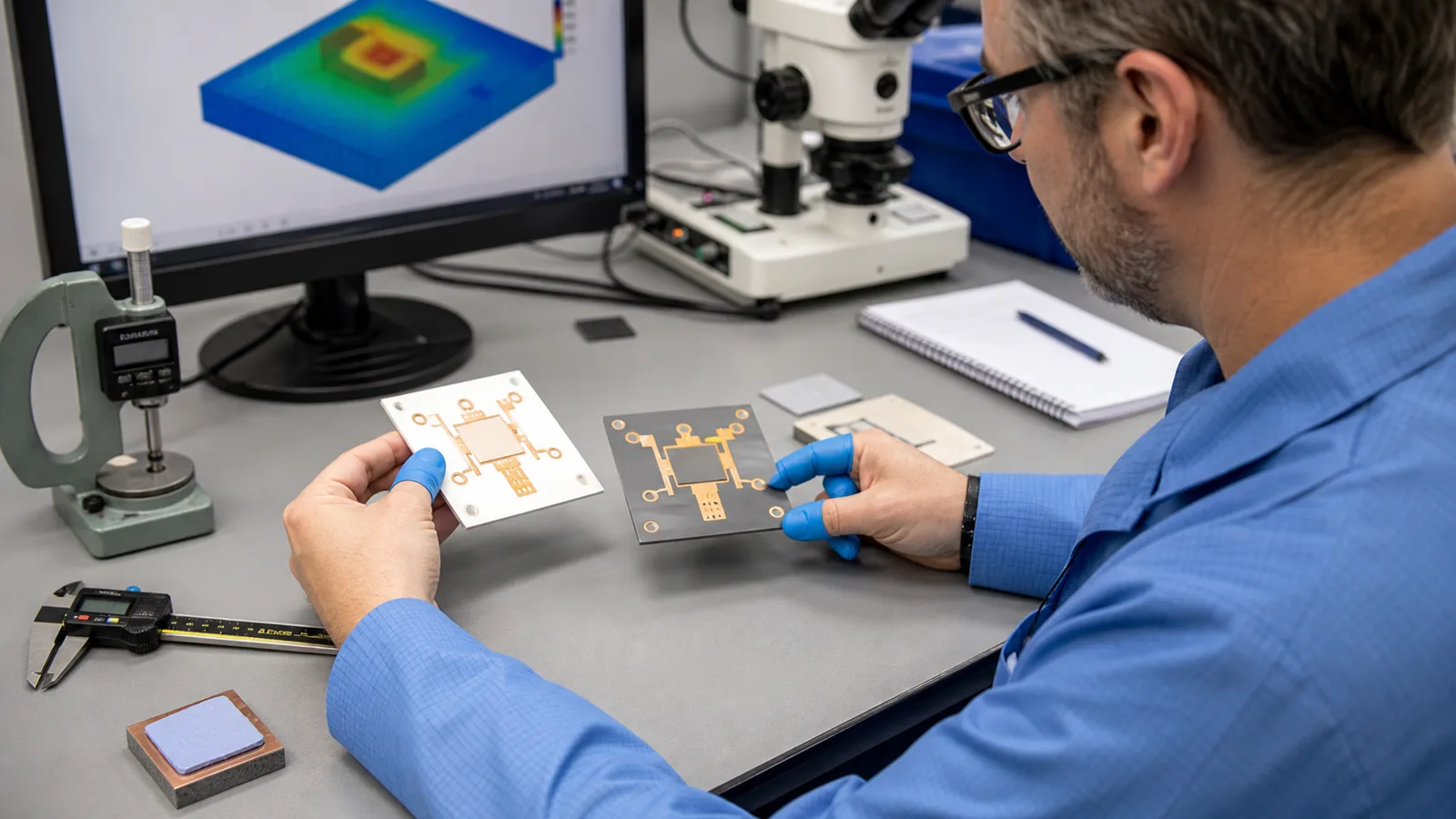
Thick film compatibility is not automatic
A thermally attractive substrate still needs compatible conductor, resistor, dielectric, and firing routes. Paste adhesion, wetting, fired expansion, atmosphere, surface chemistry, and refiring behavior are checked as a system. A resistor system qualified on alumina cannot automatically be transferred to AlN with the same result.
The assembly interface may drive metallization selection. Soldering, brazing, wire bonding, die attach, conductive adhesive, or spring contact each impose requirements for surface finish, bondability, leach resistance, adhesion, and thermal cycling. Define the downstream process early. A request for gold finish is incomplete without the underlying metallization, thickness target, bond or solder process, and acceptance method.
When each material deserves consideration
Alumina is commonly considered first when its thermal performance is compatible with the geometry, an established paste system is available, and cost or supply flexibility matters. It is offered in many compositions and formats. That does not make every alumina substrate interchangeable: purity, grain structure, roughness, camber, thickness tolerance, and laser-processing behavior can affect printing and assembly.
AlN becomes a strong candidate when thermal spreading through an electrically insulating substrate is a dominant constraint. Examples include concentrated semiconductor losses, compact power modules, and laser or optoelectronic submounts. The benefit must be confirmed at assembly level, and the drawing must account for the chosen grade, metallization route, handling, and qualification plan.
A procurement comparison that can be released
- Approved manufacturer, grade, critical property limits, and data-sheet revision.
- Outline, thickness, flatness or bow, surface roughness, hole quality, edge condition, and datums.
- Thermal-model inputs and assembly interfaces rather than conductivity alone.
- Conductor, resistor, dielectric, and protective-layer compatibility with the firing route.
- Soldering, wire bonding, die attach, brazing, coating, cleaning, and rework conditions.
- Environmental tests and acceptance criteria tied to the actual mounting and use case.
- Approved alternatives and a change-control rule for material substitution.
The best substrate is the one that closes electrical, thermal, mechanical, process, and supply requirements together. A responsible review distinguishes what the drawing confirms, what depends on material data, and what still requires prototype or assembly validation.
Primary reference
- Kyocera, Fine Ceramics product and material-property catalog — grade-specific reference data for alumina, aluminum nitride, and other technical ceramics, including stated measurement methods.
Compare substrates against the assembly
Provide loss or heater data, allowable temperature, dimensions, mounting, interface materials, metallization, assembly process, environment, and quantity.