
Overview
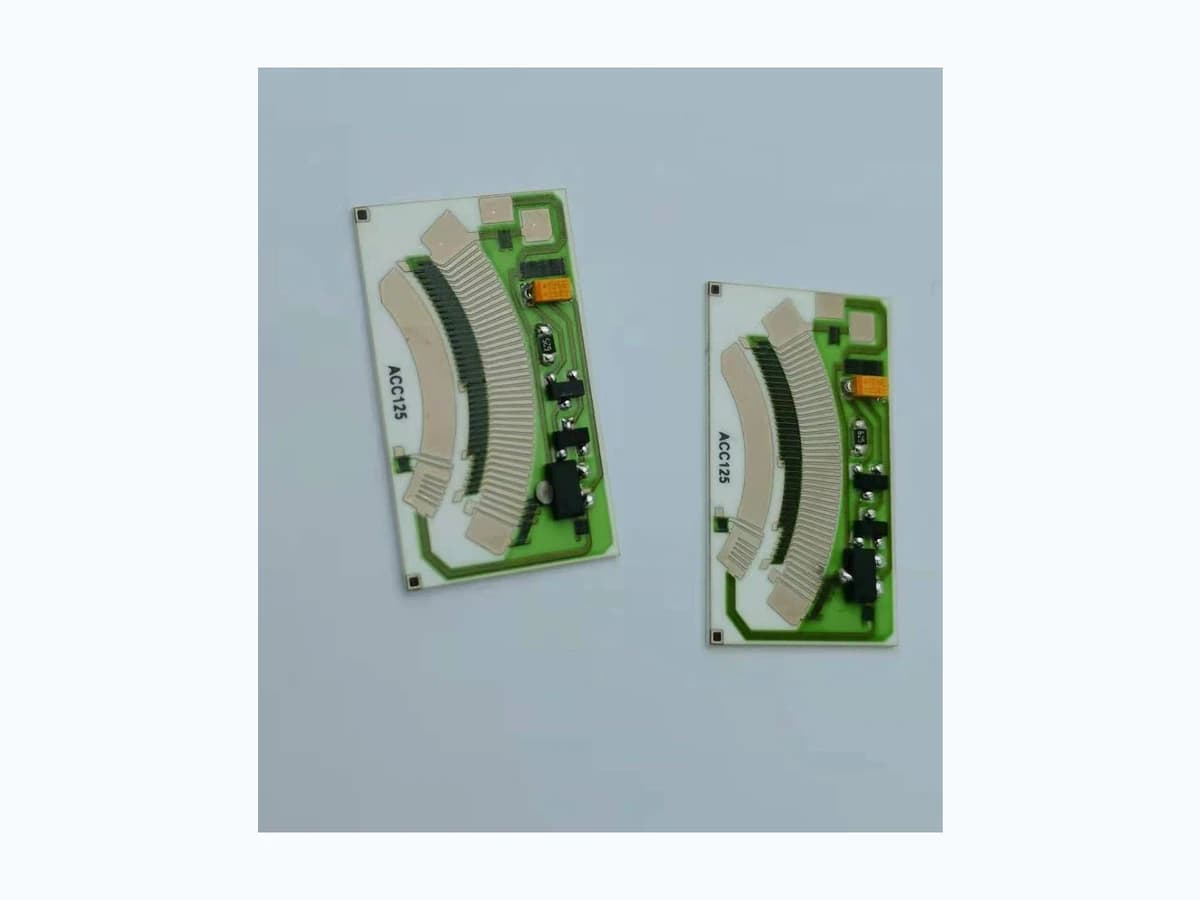
Rotary position sensing links a moving mechanism to an electrical interpretation. In a throttle or actuator, the review must include shaft angle, stops, bearings, return forces, couplings, runout, track geometry, wiper contact or another sensing principle, terminals, supply and ground, signal conditioning, controller diagnostics, enclosure sealing, contamination, vibration, temperature, calibration, and safe behavior. This guide is bounded to applications that intentionally use a compatible resistive rotary track; it does not claim that every throttle uses contact sensing or that a resistor card alone provides a safety function. The system developer selects the architecture and establishes transfer law, redundancy, plausibility rules, fault response, and vehicle or equipment validation. A visible rotary card supports discussion of geometry only, not a universal torque, angle, life, accuracy, or compliance rating.
Failure controls
These are review prompts, not evidence that every risk applies or that every test is available.
- A
Calling every rotary position sensor a potentiometer can mix contact and noncontact architectures with different interfaces, faults, and evidence needs.
- B
Endpoint calibration alone can hide local nonlinearities, discontinuities, reversal hysteresis, or track defects within the usable angle.
- C
A clean bench signal can degrade after vibration, contamination, connector movement, ground shift, wear debris, or environmental conditioning.
- D
Shared mechanical, electrical, or software paths can defeat assumed redundancy even when two output channels are present.
- E
Filtering that suppresses contact noise can also delay fault detection or dynamic response, so signal processing belongs in validation.
- F
A resistor-card test does not establish throttle return, actuator control, torque response, functional safety, or vehicle compliance.
Engineering review matrix
Each row links a design variable to evidence that can support a drawing or release decision.
| Variable | Control question | Verification route |
|---|---|---|
| Angle and datum | What mechanical feature defines zero, full travel, installation clocking, direction, stops, backlash, and tolerance stack? | Measure actual shaft or actuator angle against both raw and interpreted signals across direction, rate, temperature, and assembly variation. |
| Track law | What nominal taper, endpoint margin, linearity definition, ratio, hysteresis, repeatability, and calibration points are required? | Sweep the released mechanism with a traceable angle reference and compare data to the complete specified curve, not endpoints alone. |
| Wiper interface | What contact material, geometry, load, velocity, reversal, dwell, bounce, wear, lubricant, debris, and current define service? | Monitor contact variation and dropout with sufficient bandwidth during the representative mechanical mission profile. |
| Electrical loading | What supply, reference, input impedance, bias, filtering, sampling, protection, ADC range, grounding, and harness resistance apply? | Use the intended controller input or a documented equivalent and record signals during motion, transients, and fault injection. |
| Environmental exposure | Which temperature, humidity, condensation, vibration, shock, dust, fluid, ingress, and cleaning conditions reach the contact and terminals? | Condition representative assemblies to the system owner's sequence and repeat transfer, noise, insulation, visual, and diagnostic checks. |
| Diagnostic coverage | Which electrical and mechanical faults are detected, by what signal relationship and latency, and with what residual ambiguity? | Execute an approved fault matrix in the complete loop and compare observed response with hazard-derived requirements. |
| Change control | Which track, material, trim, wiper, housing, mechanics, connector, electronics, firmware, or calibration changes require revalidation? | Maintain configuration links between drawings, lots, software, fixtures, raw data, acceptance, deviations, and retest decisions. |
Throttle and rotary sensing review sequence
The order makes assumptions and ownership visible before a result is promoted to a requirement.
- 01
Confirm the sensing architecture
State whether the target uses a direct-contact resistive track, redundant tracks, magnetically coupled resistive element, Hall, inductive, optical, or another route. Continue with this guide only for a compatible resistive-track architecture. Record safety role, required channels, system owner, and adjacent product owners so terminology does not imply an unavailable construction.
- 02
Reference angle to mechanics
Define shaft datum, angular range, hard and soft stops, installation clocking, coupling, backlash, eccentricity, runout, bearing play, return torque, wiper preload, housing tolerance, direction, sweep rate, reversal, dwell, and overshoot. Relate the electrical track to the actual mechanism rather than to an artwork angle alone.
- 03
Specify transfer and contact behavior
Provide resistance or voltage against angle, endpoint margins, taper, independent linearity definition, hysteresis, repeatability, contact resistance variation, dropout duration, noise bandwidth, resolution, temperature effect, supply loading, and calibration method. Separate intentional shaping from deviation against the released curve.
- 04
Map environment and contamination
Identify operating and storage temperature, humidity, condensation, dust, fuels, oils, cleaning agents, salt, corrosive atmosphere, vibration, shock, pressure, ingress, lubricant, and debris generated by wear. Select test fluids and sequences from the actual installation rather than from a generic automotive label.
- 05
Design diagnostics and response
List open, short, stuck, out-of-range, implausible slope, intermittent contact, shared reference, ground offset, connector, harness, mechanical jam, spring, wiper, and controller faults. Define detection latency, state estimation, output command, warning, logging, recovery, and service action at system level.
- 06
Validate the assembled control loop
Test the intended mechanism, sensor card, wiper, housing, connector, harness, electronics, filtering, software, actuator, and feedback path. Synchronize mechanical angle, command, raw signal, interpreted position, forces, faults, and response through environmental and endurance conditions. Release traceable hardware and software revisions only.
Reference boundary
Public method sources
These sources support the engineering method and terminology used in this technical guide. They do not establish a ThickFilmPCB material list, capability limit, customer result, certification, or finished-product specification.
- 01NHTSA Laboratory Test Procedure — FMVSS 124
Defines a U.S. laboratory procedure for specified accelerator-control return behavior and requests system documentation. It helps bound throttle context but does not validate a rotary sensor, transfer law, or electronics.
- 02IEC 61508-2:2010 — E/E/PE Safety-Related Systems
Provides system-development requirements when electrical, electronic, or programmable elements perform safety-related functions. Application and sector standards, hazard allocation, integrity, and validation remain system-owner decisions.
Inputs for a practical review
Unknown values may be labelled unknown. The review should convert uncertainty into an explicit decision or validation task.
Send Drawings- 01
Target sensing architecture, equipment or vehicle function, safety role, jurisdictions, applicable standards, and validation owner
- 02
Mechanism drawing with angle, datum, clocking, stops, coupling, backlash, runout, bearings, return, wiper, housing, seal, and connector
- 03
Required transfer curve, endpoints, taper, linearity definition, hysteresis, repeatability, noise, dropout, resolution, and calibration
- 04
Supply, reference, loading, ADC, filtering, sampling, grounding, protection, harness, diagnostics, and controller interface
- 05
Contact materials, current, wiper load, travel rate, reversal, dwell, cycle profile, lubrication, wear, and service expectations
- 06
Temperature, vibration, shock, humidity, condensation, dust, fluids, salt, ingress, cleaning, storage, and combined exposure sequence
- 07
Fault list, safe behavior, warning, logging, recovery, test fixture, prototypes, acceptance criteria, and change-control rules