
On this page
A balance can establish how much material a controlled coating adds to a ceramic witness. It does not directly establish the coating's thickness. That conversion requires the area occupied by the measured material and its effective density in the fired state. Keeping these three inputs separate produces a useful areal-mass result even when thickness remains unresolved. It also prevents a nominal paste density from giving a persuasive but physically incorrect micrometre value.
Measurement purpose
Establish whether a fired-layer mass measurement supports areal mass alone or an independently defensible average thickness conversion.
Specimens and conditions
- Layer inventory
- Identify all deposited material, final fired state and exclusions from the measured mass.
- Matched witnesses
- Document uncoated firing controls, stable weighing state and correspondence to the product coating.
Equipment and records required
- Mass measurement: Resolve the coating-associated difference with controlled handling and background uncertainty.
- Area and density evidence: Provide calibrated coverage measurement and an independent density basis when converting to thickness.
Method sequence
- Inventory
Separate the coating mass boundary from substrate and other material changes.
Record: Gross readings and signed control corrections.
- Normalize
Match coated area to the measured fired mass.
Record: Coverage definition and areal mass.
- Determine identifiability
Audit effective density, shared inputs and uncertainty before conversion.
Record: Supported result and unresolved local requirements.
Decision and uncertainty
Report thickness only when isolated mass, matching area and independently justified effective density identify the required average quantity.
Background correction and density applicability may dominate instrument resolution.
The metrology reviewer approves the conversion model; the drawing owner defines whether an average quantity satisfies the requirement.
Traceable outputs
| Record | Required contents |
|---|---|
| Areal-mass record | Raw mass inventory, area basis, control behavior and uncertainty. |
| Conversion record | Density provenance, conditional equivalent thickness and separate local-integrity checks. |
Method review decisions
- Isolate the mass of one defined fired layer before dividing by area.
- Report areal mass independently of any density-based thickness estimate.
- Use a fired envelope-density basis appropriate to the actual material and porosity.
- Keep average equivalent thickness separate from local minimum and coverage integrity.
Define which fired material contributes to the mass
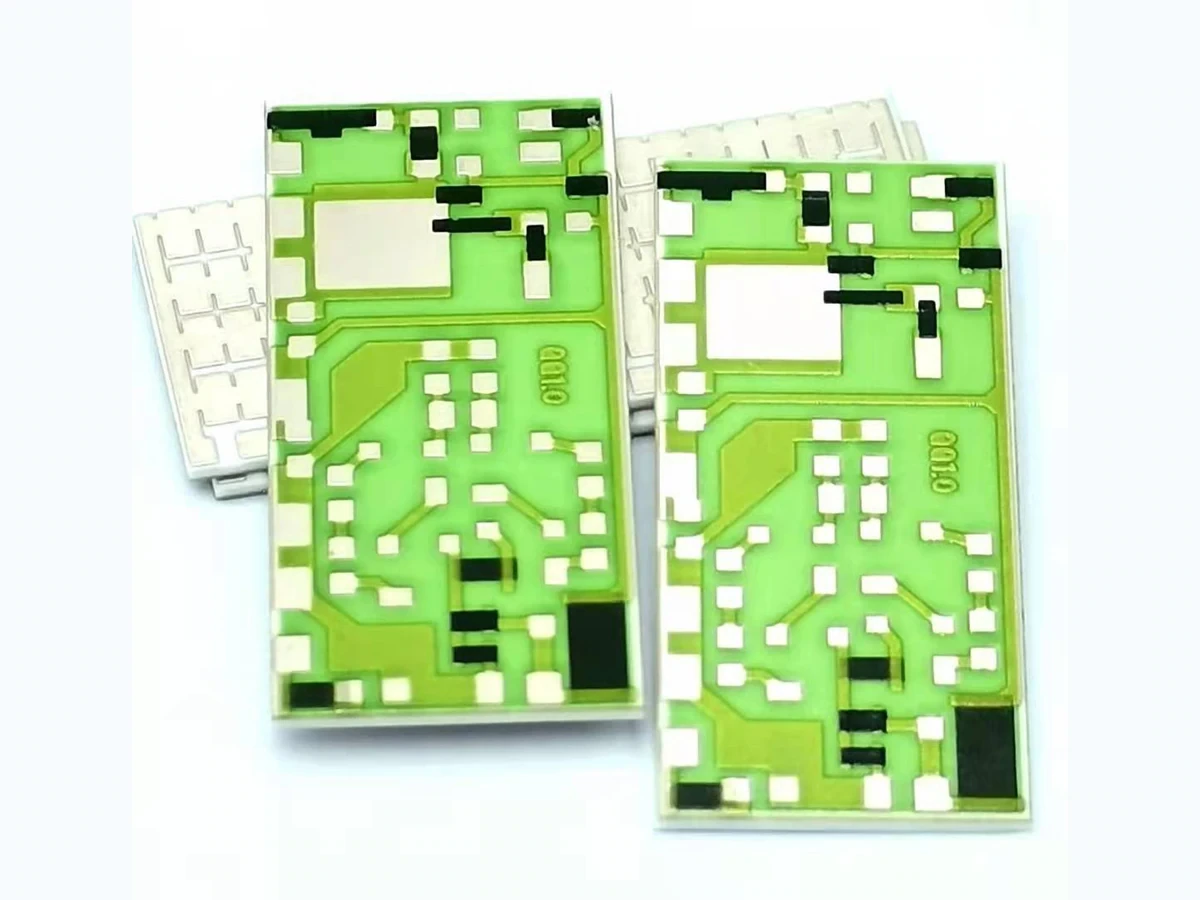
Identify the deposited layer, witness area and completed processing state. A ceramic with a conductor, resistor and protective glass has several added inventories. One final weight minus the original ceramic weight cannot distinguish those layers. An isolated-layer witness or an independently justified stage comparison is needed when the question concerns only one constituent layer.
The comparison must not include terminals, adhesive labels, carriers or loose surface deposits that are absent from the defined film volume. Preserve gross readings and object identities. Where firing changes a previously deposited layer, a later weight increment is a net process change, not automatically the mass of the newest print. State that ambiguity before calculating a thickness.
Validate the uncoated firing control
Compare pre-coating and final fired weights at compatible stable weighing conditions. A matched uncoated witness carried through the same authorized firing and handling sequence tests background change. Retain its signed change rather than assuming ceramic and fixtures contribute zero. Adsorbed moisture, transferred residue and changes at other exposed surfaces can be important relative to a small coating mass.
A control correction requires evidence that it represents the coated witness's background contribution. If controls vary substantially, subtracting their average does not remove the underlying uncertainty. Keep the uncorrected coating-associated difference alongside the adjusted result. This is a final-state inventory measurement, not a drying-rate study, and it cannot identify the chemistry of any material lost during firing.
Calculate areal mass before estimating thickness
In a hypothetical controlled witness, the adjusted fired-layer mass is 12.0 mg over 600 mm² of coating. Its areal mass is 0.0200 mg/mm², equivalent to 20.0 g/m². This result can be retained without knowing density, provided the mass and area definitions are valid. Average mass per measured area is a recognized coating measurement concept; suitability for a particular fired-paste method still requires its own validation.
Do not divide by the entire ceramic outline if part of it is deliberately uncoated. Pads, openings and test lands may occupy a substantial area. Conversely, dividing by a small inspected window is incorrect when the balance measured the coating on the entire specimen. The mass inventory and area boundary must describe the same material population.
Require a fired effective density with the correct volume boundary
Thickness inferred from mass describes the coating-envelope volume divided by coated area. The required density therefore relates fired mass to that same envelope volume, including its relevant pore space. Wet-paste density, a constituent's bulk density and a theoretical pore-free mixture density are not interchangeable with that quantity.
If an independently justified effective density is 5.0 mg/mm³, the example gives 12/(600 × 5) = 0.004 mm, or 4.0 µm. An equally plausible assumed density of 4.0 mg/mm³ gives 5.0 µm. These assumed values illustrate non-uniqueness, not a recommended density range. Without a defensible density, report the measured 20.0 g/m² and leave thickness unresolved.
q = mf / Ac; teq = q / ρeff
- mf: isolated fired-layer mass after justified background correction
- Ac: area occupied by that same measured layer
- q: fired-layer mass per coated area
- ρeff: independently supported effective fired envelope density
- teq: volume-equivalent average thickness
Mass, area and density refer to the same finished material state and volume boundary. The result is not a local thickness map.
Distinguish occupied area from the pattern envelope
A rectangular witness containing separated resistor islands has both an outer pattern envelope and the summed area of its islands. Dividing by the envelope gives a loading per envelope area; dividing by the occupied area gives a loading per coated area. Both can be useful, but they answer different questions and must not share an unlabeled thickness column.
Use the actual relevant coverage rather than blindly importing nominal artwork dimensions. Edge spread, omitted islands or uncovered holes can change the occupied area. Record whether area came from drawing geometry or calibrated inspection and how boundaries were classified. A mass-weighted average across multiple regions cannot identify which region is thin, missing or excessively thick.
Determine which input limits the converted result
For an illustrative independent-input calculation, let relative standard uncertainties be 2% for coating mass, 1% for area and 10% for effective density. First-order propagation gives approximately √(2² + 1² + 10²) = 10.25% for the converted average thickness. Increasing the balance display resolution would barely address the dominant density contribution.
Independence and small relative uncertainties are assumptions, not automatic properties of the data. If effective density was itself obtained using the same thickness measurement being checked, the comparison is circular and correlated. Do not present agreement as independent validation. Preserve the uncertainty of substrate subtraction, area classification and density transfer between witnesses and product.
Choose the result the available evidence actually supports
Use the following decision record before assigning a thickness value to a lot or adjusting a printing process. Missing information should remain a specific missing input, rather than being concealed in a nominal density field.
| Available evidence | Defensible output | Unresolved claim |
|---|---|---|
| Isolated fired mass and matching coated area | Areal mass for the defined layer | Thickness without effective density |
| Areal mass and independent representative envelope density | Volume-equivalent average thickness | Local minimum or edge profile |
| Final mass increase from several printed layers | Combined added inventory under stated controls | Individual resistor or glaze thickness |
| Nominal artwork area with visibly incomplete coverage | Qualified nominal-area loading | Thickness of continuously covered material |
| Unstable uncoated firing controls | Raw signed differences and unresolved background | Precise coating-only mass |
| Density inferred from the profiler being compared | Model consistency with shared inputs | Independent metrology agreement |
Retain a separate check for local film integrity
Equal total mass does not imply equal local thickness. A witness with a thick edge and thin centre can have the same areal mass as a uniform witness. Missing material in one location can also be offset by an excess elsewhere. Where function depends on the thinnest dielectric region, resistor geometry or terminal coverage, use a location-resolved method suited to that requirement.
The gravimetric deliverable should contain the measured areal mass, any conditional thickness conversion and its density basis as separate fields. Correlate these with independently located thickness or coverage observations when appropriate. A change in paste, firing route, coating footprint or pore structure can invalidate the previous conversion even if the balance method remains unchanged.
Send the fired-layer inventory and density basis
Provide the inputs needed to distinguish a measured coating loading from an inferred thickness.
- Layer sequence, witness drawing and final process state.
- Gross weights, uncoated firing controls and excluded objects.
- Actual coated-area definition and coverage inspection.
- Effective-density evidence and any shared measurement inputs.
- Required average thickness, local minimum or coverage decision.
The drawing-upload form loads as you reach this section.