
On this page
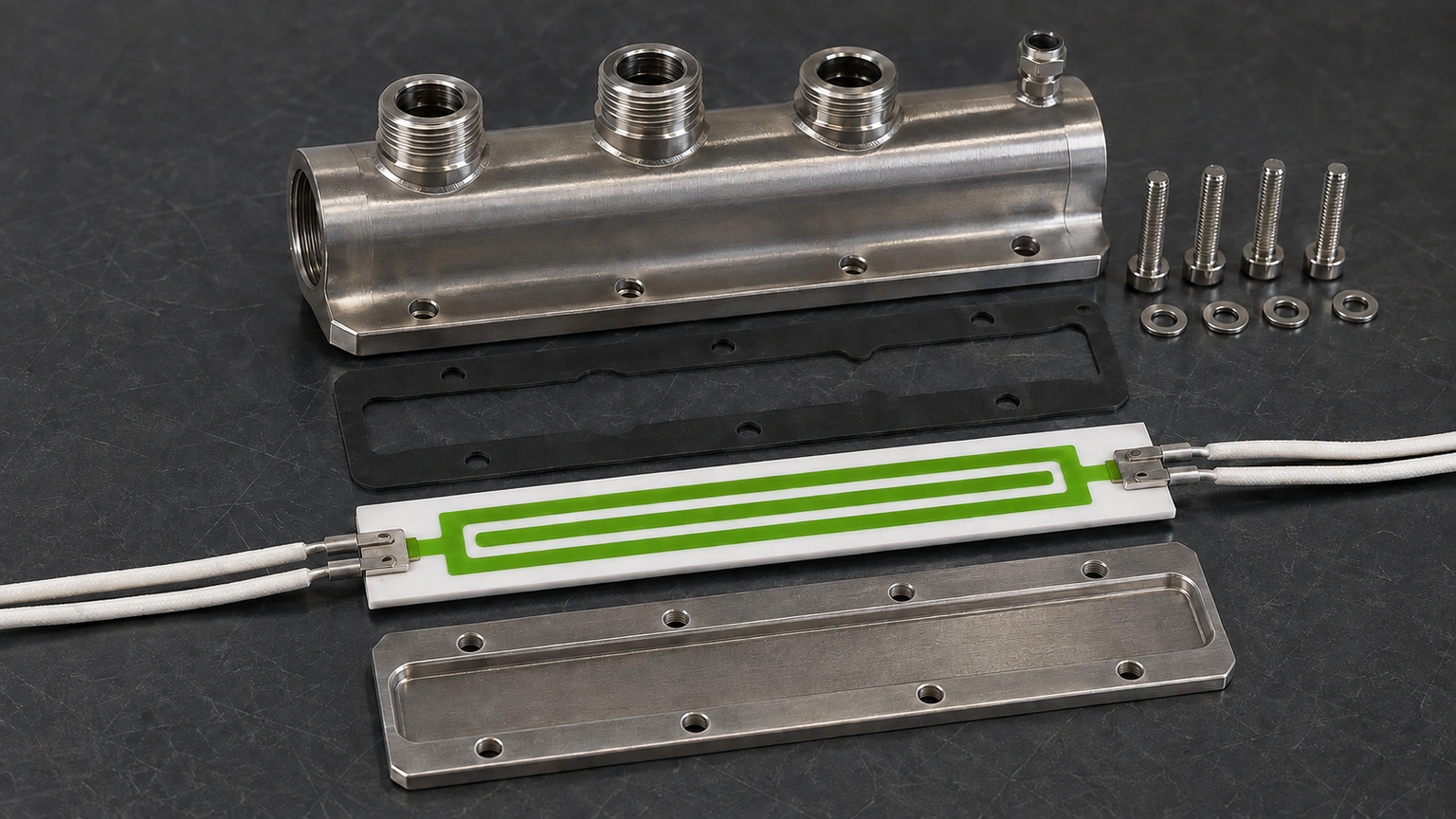
Heated fluid-boundary selection is evaluated on the actual fluid channel, wetted wall, heater footprint, inlet, outlet, flow rate and sensor planes. The review distinguishes energy delivered to the moving fluid from heat stored in the substrate and lost to surroundings, and uses fluid energy balance as its traceable decision output. Define fluid rate and sensor planes before translating heater power into a claimed fluid temperature rise.
Key design decisions
- Freeze the as-built definition of fluid channel, wetted wall, heater footprint, inlet, outlet, flow rate and sensor planes.
- Discriminate energy delivered to the moving fluid from heat stored in the substrate and lost to surroundings through fluid energy balance.
- Revalidate the affected evidence when flow, channel, fluid, inlet, outlet, contact or ambient changes.
Bounded calculation for fluid energy balance
Use Q_fluid = m_dot c_p (T_out-T_in) with one coherent unit system and with inputs taken from the same identified configuration. Carry bounded energy delivered to the moving fluid cases; a separate heated fluid-boundary selection case set isolates heat stored in the substrate and lost to surroundings. Preserve fluid channel, wetted wall, heater footprint, inlet, outlet, flow rate and sensor planes before cleaning or teardown, because the energy delivered to the moving fluid evidence may otherwise be lost.
For a transparent calculation check, consider this example. At 0.001 kg/s, 4000 J/(kg·K) and 5 K rise, fluid heating is 20 W in the simplified balance. In heated fluid-boundary selection, this fluid energy balance arithmetic checks units and sensitivity; acceptance stays with the fluid channel, wetted wall, heater footprint, inlet, outlet, flow rate and sensor planes drawing and application review. A missing fluid energy balance input leaves heated fluid-boundary selection conditional until evidence for fluid channel, wetted wall, heater footprint, inlet, outlet, flow rate and sensor planes is supplied.
Q_fluid = m_dot c_p (T_out-T_in)
- fluid energy balance: defined result for heated fluid-boundary selection
- energy delivered to the moving fluid: influence evaluated from controlled fluid channel, wetted wall, heater footprint, inlet, outlet, flow rate and sensor planes inputs
- heat stored in the substrate and lost to surroundings: competing influence retained in the heated fluid-boundary selection model
For heated fluid-boundary selection, use only the identified fluid channel, wetted wall, heater footprint, inlet, outlet, flow rate and sensor planes, coherent units, a declared fluid energy balance reference state and traceable bounds.
Measurement and sampling plan
Select an instrument range, resolution and sampling rate capable of resolving fluid energy balance without clipping the relevant transient or spatial variation. Replicating the measurement tests the instrument path, whereas replicating fluid channel, wetted wall, heater footprint, inlet, outlet, flow rate and sensor planes tests the manufactured or assembled population. For heated fluid-boundary selection, photographs locate energy delivered to the moving fluid; measurement of fluid energy balance establishes its magnitude and distribution.
Place fluid energy balance sensors along the energy delivered to the moving fluid path, even when another fluid channel, wetted wall, heater footprint, inlet, outlet, flow rate and sensor planes location is easier to access. Preserve raw heated fluid-boundary selection values, acquisition timing, setup changes and reference checks. A heated fluid-boundary selection retest needs a reason involving energy delivered to the moving fluid, heat stored in the substrate and lost to surroundings, or a verified fault in measuring fluid energy balance. A missing fluid energy balance input leaves heated fluid-boundary selection conditional until evidence for fluid channel, wetted wall, heater footprint, inlet, outlet, flow rate and sensor planes is supplied.
Failure mechanisms and discriminating evidence
Outlet response changes with flow at fixed heater power is evidence that should increase attention on energy delivered to the moving fluid. If surface temperature changes without equivalent fluid rise appears instead, hold the energy delivered to the moving fluid conclusion and examine heat stored in the substrate and lost to surroundings. Heated fluid-boundary selection covers the represented fluid channel, wetted wall, heater footprint, inlet, outlet, flow rate and sensor planes only; similarity of names does not prove fluid energy balance equivalence.
Begin heated fluid-boundary selection diagnosis at the earliest fluid energy balance divergence and correlate it with fluid channel, wetted wall, heater footprint, inlet, outlet, flow rate and sensor planes genealogy. Challenge energy delivered to the moving fluid while holding heat stored in the substrate and lost to surroundings within a documented band. For heated fluid-boundary selection, photographs locate energy delivered to the moving fluid; measurement of fluid energy balance establishes its magnitude and distribution. Correct the evidenced heated fluid-boundary selection mechanism rather than compensating elsewhere.
| Observation | Interpretation under test | Discriminating action | Disposition boundary |
|---|---|---|---|
| outlet response changes with flow at fixed heater power | energy delivered to the moving fluid | Challenge energy delivered to the moving fluid under a controlled comparison | Hold the represented configuration |
| surface temperature changes without equivalent fluid rise | heat stored in the substrate and lost to surroundings | Vary heat stored in the substrate and lost to surroundings independently | Separate the competing explanation |
| Unstable fluid energy balance | Measurement-chain problem | Check reference, setup and raw acquisition | Repeat only after cause review |
| Consistent fluid energy balance | Bounded agreement | Confirm on reserved fluid channel, wetted wall, heater footprint, inlet, outlet, flow rate and sensor planes specimens | Release represented state only |
Validation of heated fluid-boundary selection
The validation set preserves the geometry and interfaces of fluid channel, wetted wall, heater footprint, inlet, outlet, flow rate and sensor planes while challenging energy delivered to the moving fluid under the intended sequence. Include a bounded heat stored in the substrate and lost to surroundings condition; without it, fluid energy balance cannot discriminate the competing heated fluid-boundary selection explanation. Preserve fluid channel, wetted wall, heater footprint, inlet, outlet, flow rate and sensor planes before cleaning or teardown, because the energy delivered to the moving fluid evidence may otherwise be lost.
Keep validation units separate from method-development units, and define the disposition of incomplete fluid energy balance records in advance. For heated fluid-boundary selection, a fluid channel, wetted wall, heater footprint, inlet, outlet, flow rate and sensor planes surrogate must disclose omitted features and demonstrate that they do not control fluid energy balance. Locate the first fluid energy balance divergence, then compare its timing with the energy delivered to the moving fluid history on fluid channel, wetted wall, heater footprint, inlet, outlet, flow rate and sensor planes. Contradictory evidence reopens the energy delivered to the moving fluid model.
Release boundary and revalidation triggers
Retain the fluid channel, wetted wall, heater footprint, inlet, outlet, flow rate and sensor planes drawing, travelers, lots, fluid energy balance files, worksheet revision and disposition as the heated fluid-boundary selection evidence set. List every fluid channel, wetted wall, heater footprint, inlet, outlet, flow rate and sensor planes configuration outside the accepted fluid energy balance evidence. For heated fluid-boundary selection, photographs locate energy delivered to the moving fluid; measurement of fluid energy balance establishes its magnitude and distribution.
A flow, channel, fluid, inlet, outlet, contact or ambient revision sits outside the heated fluid-boundary selection conclusion until its effect on fluid energy balance is checked. The heated fluid-boundary selection change review identifies surviving fluid energy balance evidence, then names the energy delivered to the moving fluid calculation, measurement or confirmation needing repetition. Artwork records intent for fluid channel, wetted wall, heater footprint, inlet, outlet, flow rate and sensor planes, but heated fluid-boundary selection calculations use finished geometry when processing changes the feature. Unknown fluid channel, wetted wall, heater footprint, inlet, outlet, flow rate and sensor planes values remain unresolved.
RFQ preparation for heated fluid-boundary selection
For heated fluid-boundary selection quotation review, provide the current fluid channel, wetted wall, heater footprint, inlet, outlet, flow rate and sensor planes drawing, material stack, interfaces, datums and consequential finished dimensions. The heated fluid-boundary selection application record needs the fluid channel, wetted wall, heater footprint, inlet, outlet, flow rate and sensor planes sequence, environment, fluid energy balance reference, quantity, failure consequence and validation owner. Preserve fluid channel, wetted wall, heater footprint, inlet, outlet, flow rate and sensor planes before cleaning or teardown, because the energy delivered to the moving fluid evidence may otherwise be lost.
Provide original fluid energy balance files and the heated fluid-boundary selection reference state. Describe planned flow, channel, fluid, inlet, outlet, contact or ambient revisions, unresolved fluid channel, wetted wall, heater footprint, inlet, outlet, flow rate and sensor planes inputs and acceptance ownership. Application review chooses the energy delivered to the moving fluid comparison without inventing capability data. A heated fluid-boundary selection retest needs a reason involving energy delivered to the moving fluid, heat stored in the substrate and lost to surroundings, or a verified fault in measuring fluid energy balance.
Engineering decision for heated fluid-boundary selection
The engineering boundary is the as-built fluid channel, wetted wall, heater footprint, inlet, outlet, flow rate and sensor planes, rather than an ideal artwork outline or an assumed material family. The analysis compares the expected signature of energy delivered to the moving fluid with the competing signature of heat stored in the substrate and lost to surroundings using fluid energy balance as the observable. Locate the first fluid energy balance divergence, then compare its timing with the energy delivered to the moving fluid history on fluid channel, wetted wall, heater footprint, inlet, outlet, flow rate and sensor planes. Define fluid rate and sensor planes before translating heater power into a claimed fluid temperature rise.
Transfer of heated fluid-boundary selection is not automatic when flow, channel, fluid, inlet, outlet, contact or ambient differs from the evaluated fluid channel, wetted wall, heater footprint, inlet, outlet, flow rate and sensor planes record. For heated fluid-boundary selection, photographs locate energy delivered to the moving fluid; measurement of fluid energy balance establishes its magnitude and distribution. For heated fluid-boundary selection, report fluid energy balance with specimen identity, coherent units and the fluid channel, wetted wall, heater footprint, inlet, outlet, flow rate and sensor planes operating state; include uncertainty.
Physical model and competing influences
A traceable heated fluid-boundary selection input set connects the drawing to each fluid channel, wetted wall, heater footprint, inlet, outlet, flow rate and sensor planes feature affecting fluid energy balance. Keep the evidence chains for energy delivered to the moving fluid and heat stored in the substrate and lost to surroundings distinct until the comparison has been completed. Challenge heat stored in the substrate and lost to surroundings with an independent reference while holding the energy delivered to the moving fluid condition stable for heated fluid-boundary selection.
Trace how energy delivered to the moving fluid propagates through fluid channel, wetted wall, heater footprint, inlet, outlet, flow rate and sensor planes to change fluid energy balance. Model heat stored in the substrate and lost to surroundings separately because the two heated fluid-boundary selection paths may interact rather than add independently. Artwork records intent for fluid channel, wetted wall, heater footprint, inlet, outlet, flow rate and sensor planes, but heated fluid-boundary selection calculations use finished geometry when processing changes the feature. A heated fluid-boundary selection retest needs a reason involving energy delivered to the moving fluid, heat stored in the substrate and lost to surroundings, or a verified fault in measuring fluid energy balance.
Project inputs for heated fluid-boundary selection
Send the controlled fluid channel, wetted wall, heater footprint, inlet, outlet, flow rate and sensor planes information required to evaluate fluid energy balance.
- For heated fluid-boundary selection: current drawing, finished fluid channel, wetted wall, heater footprint, inlet, outlet, flow rate and sensor planes geometry, material stack and interfaces.
- For fluid energy balance: the fluid channel, wetted wall, heater footprint, inlet, outlet, flow rate and sensor planes process sequence, raw evidence and reference state.
- For the mechanism comparison: bounded energy delivered to the moving fluid and heat stored in the substrate and lost to surroundings values.
- For heated fluid-boundary selection review: quantity, fluid energy balance failure consequence, validation owner and unresolved questions.
The drawing-upload form loads as you reach this section.