
On this page
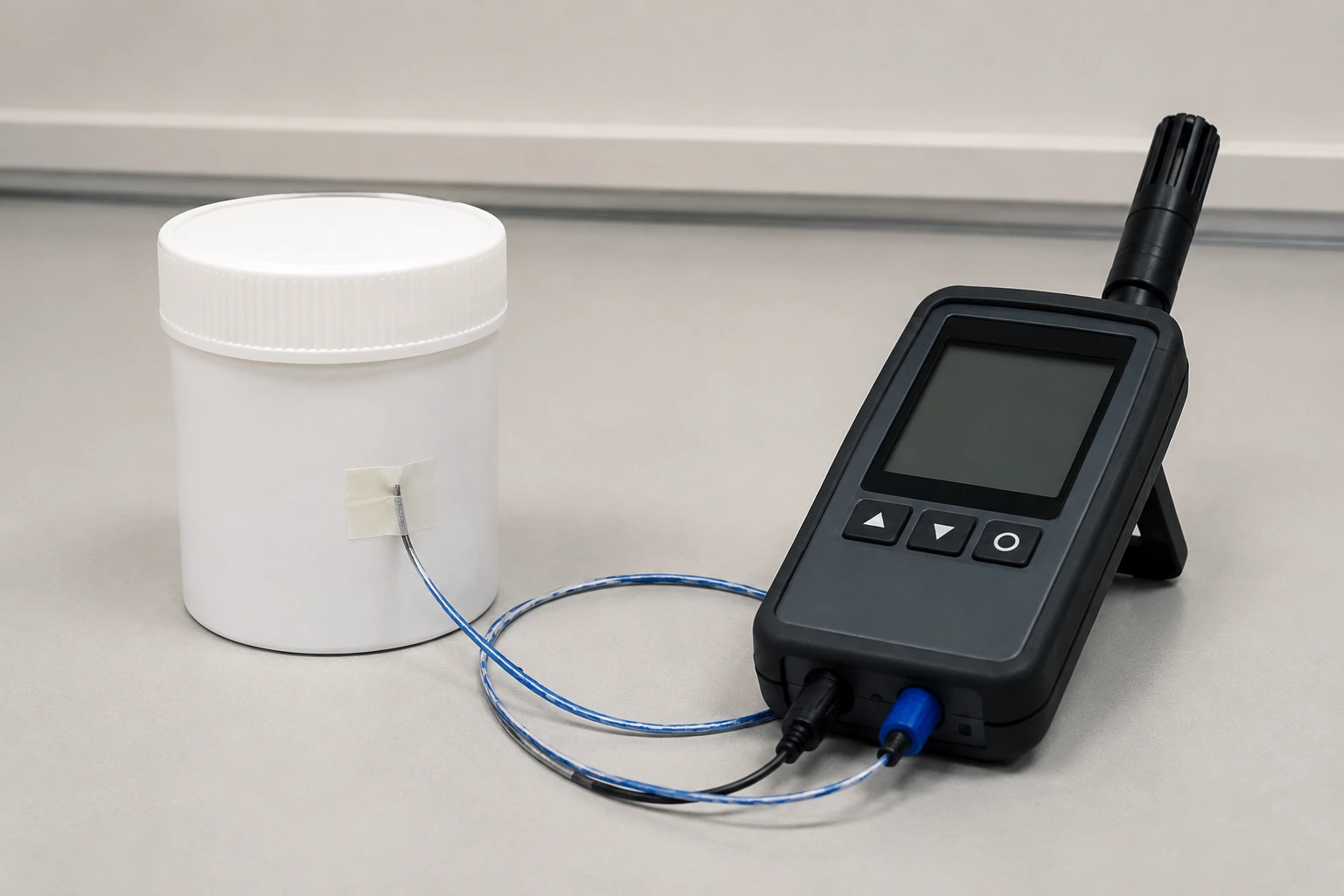
A paste container can feel warm outside while its contents remain colder. Opening at that point exposes the paste, lid underside and rim to room air, so an exterior temperature reading alone cannot establish readiness. The decision needs two separate checks: the supplier's temperature-equilibration requirement and a condensation margin that accounts for the coldest relevant surface, local humidity and measurement uncertainty. Package-specific thermal measurements connect those checks to an observable opening criterion without relying on a universal waiting time.
Key design decisions
- Establish the relation between measured container surfaces and the slowest-warming internal locations for each qualified package and fill range.
- Compare a conservative internal-temperature estimate with an upper dew-point bound, not only nominal room temperature or relative humidity.
- Require both supplier-specified equilibration and the validated condensation margin before opening; restart the assessment when conditions change.
Separate the supplier's opening requirement from condensation clearance
Follow the selected paste grade's specified storage range and opening-equilibration condition. Refrigeration, warming and opening requirements are material-specific and must not be transferred between conductor, resistor and dielectric formulations. Identify the controlled instruction for the actual grade and package before choosing the conditioning environment or evaluating when the contents are ready for opening.
Being above the dew point is a moisture-risk check, not a substitute for the material's required temperature state. A container may clear the condensation threshold well before its contents approach room temperature. Identify the actual grade, current handling instruction and permissible conditioning environment first. Where the supplier does not quantify equilibration, agree a measurable interpretation through material and process review. Do not infer that an arbitrary surface reading satisfies the instruction.
Locate the coldest relevant region, not the easiest surface to measure
Heat reaches the outside of a sealed container before it reaches every internal location. The sidewall, bottom contact area, paste interior and lid underside can follow different temperature histories. Fill depth, container material, packaging insulation and bench contact affect that history. A small sample cup therefore cannot establish the opening criterion for a larger jar merely by scaling the waiting time with mass.
The paste core is important to equilibration even when it will not be directly exposed at opening. The paste surface and lid underside matter to moisture exposure. Map both functions during qualification. A stable outer-wall reading can coexist with a remaining internal gradient; stability at one location is not proof of equilibrium everywhere. Avoid hand warmth or an unvalidated infrared spot reading as the sole decision input. Neither establishes the temperature of the hidden material.
Calculate dew point from the air that will contact the opened container
Dew point describes the temperature at which water vapor reaches saturation. Measure air temperature and relative humidity at the opening station, with the sensor equilibrated and positioned to represent that air. A reading beside a warm machine or across the room may describe a different exposure. Humidity changes near doors and airflow paths can invalidate an earlier measurement.
For this saturation-vapor-pressure approximation over water, restrict both air temperature and calculated dew point to 0–50°C. Use RH as a percentage, not a fraction. Reject zero or invalid RH inputs; use a suitable validated method outside these bounds, including frost conditions or pressurized gas.
Pws = A × 10^(m × Tair / (Tair + Tn)); Pw = (RH / 100) × Pws; g = log10(Pw / A); Td = Tn × g / (m − g)
- Tair and Td: air temperature and dew point in °C.
- Pws and Pw: saturation and actual water-vapor partial pressure in hPa.
- RH: relative humidity in percent, with 0 < RH ≤ 100.
- g: dimensionless base-10 logarithm of the ratio Pw / A; g = 0 gives Td = 0°C directly.
- A = 6.1162 hPa, m = 7.5892 and Tn = 240.71°C; logarithm base 10.
Approximation for water vapor in ordinary ambient air, not a solvent-vapor or sealed-container headspace model. At 25.0°C and 60% RH, the calculation gives Td = 16.69°C.
Test the adverse bounds rather than comparing nominal readings
Build working bounds that include measurement uncertainty, sensor placement and the validated difference between external readings and internal temperature. Calculate the highest dew point across the permitted air-temperature and humidity bounds. Compare it with the lowest credible temperature of the relevant cold region. Keep any additional operating margin explicit; its value belongs to the qualified method, not a universal rule.
For a numerical example, assume air at 25.0 ± 0.3°C and 60 ± 3 percentage points RH. Evaluating the upper corner, 25.3°C and 63% RH, gives a dew point of 17.75°C. A shell reading of 18.0°C appears clear of the nominal 16.69°C dew point. However, subtracting a 0.4°C temperature bound and a demonstrated 2.0°C internal lag gives only 15.6°C. The container fails the condensation check even before adding an operating margin. These illustrative bounds are not instrument specifications or measured company results.
This is conservative interval reasoning, not a statistical confidence calculation. Avoid counting the same sensor contribution twice when the thermal-lag study already includes it. Equality with the dew-point boundary is not positive clearance.
Measure the warm-up behavior of the actual package configuration
Use a dedicated qualification container with the same geometry, closure, fill range and relevant thermal properties as the production package. Instrument the critical regions identified above through a suitably sealed arrangement. Opening an ordinary production jar to insert a probe changes the condition being evaluated and can introduce contamination. A substitute fill material needs demonstrated thermal equivalence; matching mass alone is insufficient.
Record starting temperatures, air temperature and humidity, package orientation, outer packaging, support contact and airflow. Compare interior and exterior traces through the full transition. Include repeat runs and the slowest credible combinations rather than selecting the fastest observed result. Derive the maximum remaining internal lag associated with a practical external measurement condition.
Retain the measurement positions and uncertainty treatment with that relationship. Do not extrapolate the resulting readiness rule to a different lid, fill depth, insulating carton or conditioning surface without checking whether the thermal relationship still holds.
Require all opening conditions to pass together
The opening decision combines supplier compliance, thermal evidence and current environmental conditions. A passed item cannot compensate for a failed or unknown item elsewhere. The table distinguishes a genuinely ready container from situations that require further waiting, measurement or technical review.
| Observed condition | Meaning | Opening decision |
|---|---|---|
| Shell exceeds nominal dew point; internal lag unknown | Exterior clearance does not bound the colder interior | Keep sealed and establish the internal-temperature relationship |
| Condensation margin passes; supplier equilibration not met | Moisture clearance and required material state differ | Continue conditioning within the permitted environment |
| Supplier requirement and uncertainty-adjusted margin pass | Thermal and moisture conditions support opening | Open only with a dry, clean exterior and a valid handling record |
| Humidity rises after the readiness check | The earlier dew-point calculation may no longer apply | Recalculate using current station conditions before opening |
| Package or fill is outside the studied range | The established lag bound is not transferable | Use an appropriately qualified rule or complete a thermal study |
| Water remains around the closure | Droplets can enter mechanically during lid removal | Keep sealed; resolve exterior moisture without contaminating the rim |
Translate qualification data into repeatable station measurements
A routine method should identify the external sensor position, contact method, reading stability condition and the qualification rule used to infer internal readiness. Protect that measurement from hand contact and changes in support or airflow. Where infrared measurement is used, validate its relationship to the contact measurement for the actual surface rather than assuming the displayed temperature is interchangeable.
Capture ambient readings close to the opening event. Define when a changed room condition, relocation or excessive delay requires reassessment. A container marked ready elsewhere should not carry that status indefinitely into a more humid area. Likewise, time out of storage is supporting history, not an automatic opening authorization. Package-specific measured behavior and the current condensation boundary remain the decision inputs.
Retain the evidence behind the opening decision
The record should connect paste grade and lot to package identity, starting condition, thermal-rule revision, measured values, uncertainty bounds and the opening time. Record which supplier requirement was satisfied and the resulting condensation clearance. A simple statement that the jar was left at room temperature does not reveal whether the interior equilibrated or the room humidity changed.
Review the rule when container construction, fill range, permitted storage condition or conditioning arrangement changes. If condensation is suspected after opening, isolate the material for disposition under the grade-specific quality procedure; subsequent warming does not establish that moisture was never introduced. Once opening readiness is established, use the separate receiving and conditioning procedure for downstream handling. Keeping this thermal decision distinct makes its evidence easier to verify and its failure causes easier to investigate.
Send the container warm-up measurements
Provide the package and environmental information needed to evaluate the opening criterion.
- Paste grade, current supplier opening instruction, package dimensions, container construction and fill range.
- Initial material condition, conditioning arrangement and time-linked internal and exterior temperature traces.
- Opening-station air temperature and humidity, measurement positions, uncertainty bounds and relevant environmental changes.
- Proposed equilibrium criterion, validated internal-lag bound, dew-point calculation and additional operating margin.
The drawing-upload form loads as you reach this section.