
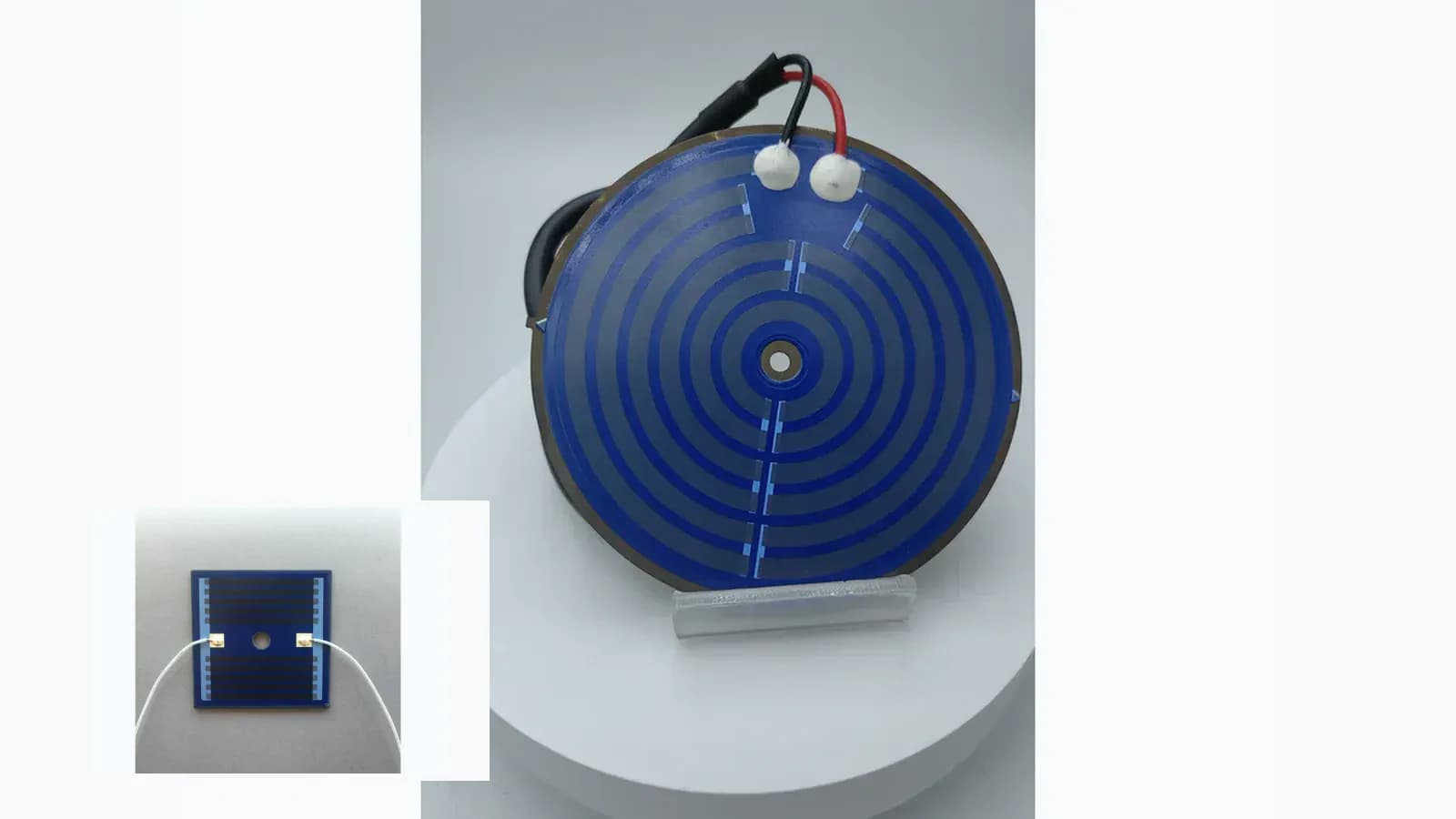
Overview
This product selection record defines a drawing-led selection boundary for Stainless Steel Thick Film Heater. It separates the requested construction from adjacent routes and identifies material, geometry, interface, inspection, and supply evidence needed before quotation or publication.
Engineering review matrix
Each row links a design variable to evidence that can support a drawing or release decision.
| Variable | Control question | Verification route |
|---|---|---|
| Electrical target | For Stainless Steel Thick Film Heater, define voltage, resistance, current, power, duty cycle, and tolerance at the assembly operating point. | Measure cold and operating resistance, current, power, and protective response under the agreed supply condition. |
| Heat path | Substrate, mounting, fluid or air flow, contact resistance, insulation, and ambient determine temperature—not nominal watts alone. | Map temperature at steady state and during transients at relevant boundary conditions. |
| Printed geometry | Trace width, thickness, turns, spacing, neck-downs, and terminal transitions control local current density and heat flux. | Inspect processed geometry and correlate critical regions with the thermal map. |
| Insulation and protection | Working voltage, dielectric stack, creepage, clearance, moisture, scale, and dry-run exposure must be reviewed together. | Use a construction-specific insulation, dielectric, leakage, and environmental plan. |
| Control interface | Sensors, cut-outs, bonding, terminals, control algorithm, and fault state belong to the heater system boundary. | Validate warm-up, overshoot, cycling, sensor response, and defined fault cases in the final assembly. |
Selection route
The order makes assumptions and ownership visible before a result is promoted to a requirement.
- 01
Define the functional job
For Stainless Steel Thick Film Heater, document the functional requirement, operating boundary, interfaces, quantities, and acceptance owner against the current drawing.
- 02
Separate adjacent process routes
For Stainless Steel Thick Film Heater, compare the applicable material and process routes, recording compatibility limits, trade-offs, and verification needs before selection.
- 03
Release geometry and interfaces
For Stainless Steel Thick Film Heater, control dimensions, datums, layer stack, interfaces, tolerances, and assembly constraints in the released drawing.
- 04
Agree inspection evidence
For Stainless Steel Thick Film Heater, agree the inspection method, sample plan, acceptance criteria, traceability, and report format before validation.
- 05
Quote against the controlled drawing
For Stainless Steel Thick Film Heater, control dimensions, datums, layer stack, interfaces, tolerances, and assembly constraints in the released drawing.
Failure controls
These are review prompts, not evidence that every risk applies or that every test is available.
- A
Local hot spot at a turn, neck-down, terminal, void, or poor thermal interface
- B
Resistance drift or protection damage after thermal cycling
- C
Dielectric breakdown, leakage, or corrosion under moisture, scale, or contamination
- D
Runaway temperature when flow, contact, sensing, or control is lost
Inputs for a practical review
Unknown values may be labelled unknown. The review should convert uncertainty into an explicit decision or validation task.
Send Drawings- 01
Supply voltage and tolerance; target power or resistance
- 02
Thermal load, mounting stack, medium, flow, ambient, and duty cycle
- 03
Allowed temperature field, warm-up time, and fault limits
- 04
Outline, keep-outs, terminal and sensor interfaces
- 05
Electrical, thermal, cycling, and safety tests