
On this page
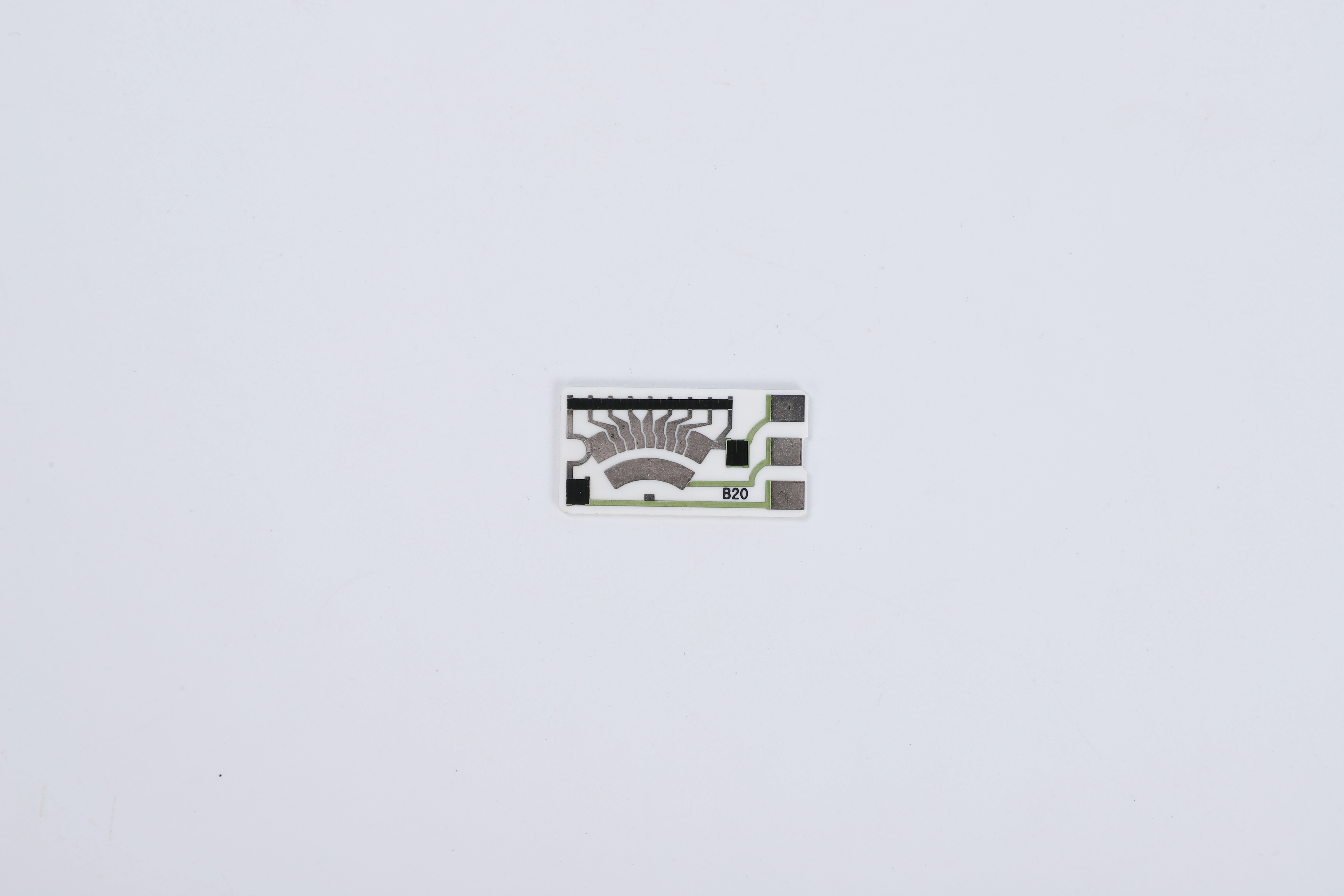
A fuel-level signal deliberately filtered to suppress motion-induced fluctuations may respond too slowly when the tank is refilled. The answer is not simply to make the filter faster everywhere. The controller needs a defined refueling-event boundary: what evidence establishes a new level, when the old filter state is replaced, and what happens if the signal becomes invalid before confirmation. The passive resistor card supplies a bounded electrical position signal; it cannot identify refueling by itself.
System boundary
The resistor-card sender, acquisition validity, tank calibration and controller event/display states define the reviewed interface. Refueling recognition and system safety are owned by the complete equipment design.
Integration interfaces
| Interface | Required input | Thick film role | Validation owner |
|---|---|---|---|
| Sender acquisition | Excitation, raw signal limits, timestamps and contact-fault interpretation | Provide the drawing-defined position-to-resistance transfer | Sender and acquisition electronics owner |
| Event context | Available motion, attitude and refueling-context evidence | Supply a passive signal without implying knowledge of vehicle state | System controls owner |
| Display-state update | Filter, rate-limit and baseline commit rules | Remain tied to the approved static signal mapping | Firmware and gauge integration owner |
Integration risks
| Risk | Control or verification | Validation owner |
|---|---|---|
| Slosh or an electrical fault is accepted as added fuel | Require declared context and independent input validity before commit | System controls owner |
| Old downstream state preserves delay after refueling confirmation | Update all approved stateful blocks coherently | Firmware owner |
| Missing or clipped samples falsely satisfy stability | Track timestamps, raw range and invalid intervals explicitly | Acquisition validation owner |
System integration decisions
- Separate a candidate rise from an accepted refueling event.
- Define how a confirmed new level replaces both filter memory and any display rate-limit state.
- Preserve raw electrical diagnostics so a high fault value is not accepted as added fuel.
Keep event handling separate from the static calibration curve
Begin with an already defined mapping from sender resistance or voltage to level or volume at a stated tank attitude. A refueling algorithm cannot correct an incorrect float linkage, tank table or electrical scaling. The task here is narrower: decide when a persistent change represents a new operating state rather than a disturbance to be suppressed.
Name the signal used for that decision. A heavily filtered display is a poor sole witness for an event whose recognition the same filter delays. Retain time-stamped raw electrical data, its validity state and the calibrated but unfiltered quantity. Motion, attitude and any available refueling-context signals belong to the controller interface, not to a claimed capability of the printed card.
Quantify the delay that the old filter state creates
For an illustrative first-order display model with time constant 60 seconds, suppose the accepted pre-fill quantity is 15 litres and the newly stabilized true input is 40 litres. After 30 seconds of ordinary filtering, the display is approximately 24.84 litres, still 15.16 litres below the new input. Reaching within one litre takes approximately 193.1 seconds. These assumed values show a state-memory effect; they are not fuel-gauge requirements.
A separate upward rate limit can preserve delay even if the smoother is reset. At an illustrative 0.2 litre per second display limit, a 25-litre rise requires at least 125 seconds. Inventory every stateful block between raw signal and display. Resetting one variable while leaving a downstream limiter initialized to the old level does not produce the intended refueling response.
y(t) = xnew + (y0−xnew) exp(−t/tau)
- y0: accepted display value before the step
- xnew: constant newly stabilized input quantity
- tau: positive filter time constant; t: time after the step
A continuous first-order model, fixed new input and no additional clipping or rate limit; the actual digital implementation must be evaluated with its own update rule.
Require context before accepting a level increase
A rising sender signal can also come from attitude change, fluid movement, a sticking float that releases, a wiring interruption or acquisition recovery. The event decision therefore needs more than a positive slope. Specify the available contextual evidence, such as a stationary operating state, a valid pre-event baseline and a sustained post-event electrical reading under permitted attitude conditions.
No single contextual input is universally available or sufficient. Ignition state alone does not prove that fuel was added, and a stable sender does not prove a level tank. Where context is unavailable, the product owner must define a conservative response and its display consequences. Do not label a threshold or dwell time as universal across tank shapes, sender mechanisms and controller architectures.
Make state transitions and exit conditions explicit
Use a state record that separates observation from acceptance. A candidate event can collect evidence without immediately overwriting the last accepted level. If the evidence becomes invalid, retain that distinction rather than quietly treating a partial sequence as successful refueling.
| State | Required evidence or action | Exit and retained record |
|---|---|---|
| Normal tracking | Valid signal processed under the normal motion policy | Save an identified pre-event baseline |
| Candidate rise | Plausible increase with declared context | Start confirmation timing without committing a new level |
| Post-fill confirmation | Valid stabilized samples within the specified context | Accept a new value or abandon the candidate |
| Commit new baseline | Update approved filter and display states together | Record old value, new value and transition reason |
| Return to normal | Resume the normal policy from the committed state | Retain the event identifier and software configuration |
| Invalid input | Electrical fault, stale data or missing required context | Use the defined invalid-state response; do not call it refueling |
Measure confirmation time from valid evidence
A confirmation interval should describe elapsed time with acceptable evidence, not merely a count of loop executions. Missing samples, task delays and stale communication values can otherwise make a short or interrupted record appear stable. State whether an interruption restarts the dwell, pauses it or abandons the candidate, and retain the reason in the event log.
Define which value is committed at the end of confirmation: a specified post-event estimator, a bounded sample group or another reviewed quantity. The final sample alone may coincide with residual motion. Keep the commit operation coherent across filter memory, rate-limit state, displayed value and any consumption estimate that uses the fuel baseline. Partial updates can create a jump that is later mistakenly attributed to the resistor card.
Do not accept a clipped signal as a confirmed full tank
The sender may reach a mechanical stop, the acquisition may saturate, or software may clip values to a displayed full limit. Those states have different meanings. A repeated maximum code can look perfectly stable while carrying no information about further level change. Retain unclipped acquisition diagnostics and distinguish a valid full-region reading from an electrical overrange or a frozen communication value.
Open circuits and intermittent wiper contact require an independent validity rule appropriate to the actual excitation and receiver. Depending on the interface, an open can drive the reading high, low or to a plausible biased value. Do not clear an electrical fault simply because an event detector sees a large increase. Likewise, a candidate that ends when the vehicle changes attitude should not automatically establish that the apparent increase was genuine fuel addition.
Verify event logic with labelled signal sequences
Begin controller verification with safe electrical replay or recorded-data replay, using independently labelled sequences. Include a genuine persistent increase, a temporary rise that returns to baseline, a rise followed by contact loss, a missing-data interval, a saturated endpoint and a power interruption during commit. Record the raw input, validity, event state, filter state and final display on the same time base.
Then correlate the selected behaviour with representative system evidence obtained under the equipment owner's approved fuel-handling and test procedures. This page does not prescribe fuel transfer or tank access operations. The replay checks logic consistency; physical validation establishes whether the assumed signal patterns and context actually represent the tank and sender. Neither one alone proves complete gauge accuracy or vehicle safety.
Release the event behaviour as a versioned interface
The acceptance record identifies the baseline rule, candidate evidence, confirmation estimator, elapsed-time handling, commit targets and invalid-state response. Include the expected display trajectory for each labelled sequence, not just the final number. Specify when normal tracking resumes and how a controller restart recovers an interrupted event.
Reopen the review after changing tank calibration, card transfer, sample timing, communication handling or display smoothing. A resistor card with unchanged geometry can appear unresponsive when downstream state handling changes. Keeping the event logic separate from the static curve allows the team to correct the actual cause without reshaping a valid printed track to compensate for stale software memory.
Provide the sender and refueling-event interface
Send both the static transfer and the time-stamped controller behaviour so card geometry and event handling remain separate decisions.
- Sender card transfer, excitation and electrical fault states
- Tank calibration and permitted attitude conditions
- Raw and filtered event records with timestamps
- Available context signals and event-state definition
- Filter/rate-limit initialization, commit and recovery acceptance
The drawing-upload form loads as you reach this section.