
On this page
- Use Silver Where Its Strengths Are Protected
- Use Ag-Pd to Balance Joining and Stability
- Reserve Platinum Systems for the Required Environment
- Choose Gold for a Joining System, Not Its Colour
- Consider Mixed Metallurgy as an Interface Design
- A Worked Engineering Review
- Design Review Checklist
- Questions Engineers Commonly Ask
- Related Engineering Resources
- Closing Note
Prepared by Chipsimple Engineering Team, Engineering and technical content review
Published online August 10, 2026 · Reviewed August 10, 2026
ENGINEERING ARTICLE 08 / VOLUME 2
Choosing a Thick Film Conductor System: Silver, Ag-Pd, Platinum and Gold
The conductor with the lowest bulk resistivity is not automatically the best circuit conductor. A fired thick-film layer includes interfaces and a joining surface, and it may be exposed to multiple firings, humidity, bias, solder or wire bonding. Material choice should therefore start with current, environment and assembly, then confirm paste compatibility with the ceramic and other printed layers.

Use Silver Where Its Strengths Are Protected
Silver offers high conductivity and favourable cost but needs review for migration, solder interaction and environment. The consequence is that closely spaced biased conductors in humid contamination can carry a different risk from a sealed low-voltage path. In a thick film conductor materials review, this relationship deserves an explicit decision rather than an assumption copied from a previous drawing.
The practical control is to define voltage, spacing, humidity, surface cleanliness and protection strategy. That instruction should be linked to the layer, material system or feature it governs so that production and inspection read it in the same way.
Verification should include biased humidity or insulation testing on the representative geometry. If the evidence is collected only after final assembly, the team loses the ability to separate printing, firing, trimming and assembly effects.
A common warning sign is progressive leakage or dendritic growth that does not appear in dry room-temperature testing. Treat that symptom as a request to examine the process chain, not simply as a reason to widen the final tolerance.
Use Ag-Pd to Balance Joining and Stability
Palladium modifies silver behaviour and can improve resistance to solder leaching and migration. The consequence is practical: higher palladium content may increase conductor resistance and cost while changing bond or solder response. This is one reason thick film conductor materials cannot be reduced to a single catalogue value.
During design review, select composition around the actual joining cycle and electrical path. The objective is not to freeze every process setting on the customer drawing, but to define the functional boundary that the manufacturer must protect.
A useful evidence package contains solderability, leach resistance, adhesion and path resistance after thermal exposure. Comparing those records with the approved construction is more informative than judging an isolated photograph or one resistance reading.
Watch for choosing composition by tradition rather than the current solder alloy and time-temperature profile. It often indicates that two individually acceptable variables have combined at the edge of their windows.
Reserve Platinum Systems for the Required Environment
Platinum-bearing conductors are used when temperature, chemical exposure or noble-metal compatibility justifies them. Consequently, their electrical resistance and cost require deliberate path sizing and selective use. The engineering value comes from understanding the direction and sensitivity of the effect, not from memorising a nominal number.
A robust drawing or process plan will identify which regions need the environmental capability and avoid applying premium metallurgy everywhere. This makes the design intent visible and gives the supplier room to use a qualified material set without changing the function.
The result can be checked through ageing under the target temperature and atmosphere plus joining tests. Where possible, keep readings before and after the next thermal or mechanical operation; the delta often reveals more than the final value.
The failure pattern to investigate is a costly full-area solution that still fails at an unqualified termination interface. Before changing materials, confirm orientation, lot history, measurement method and acceptance limits.
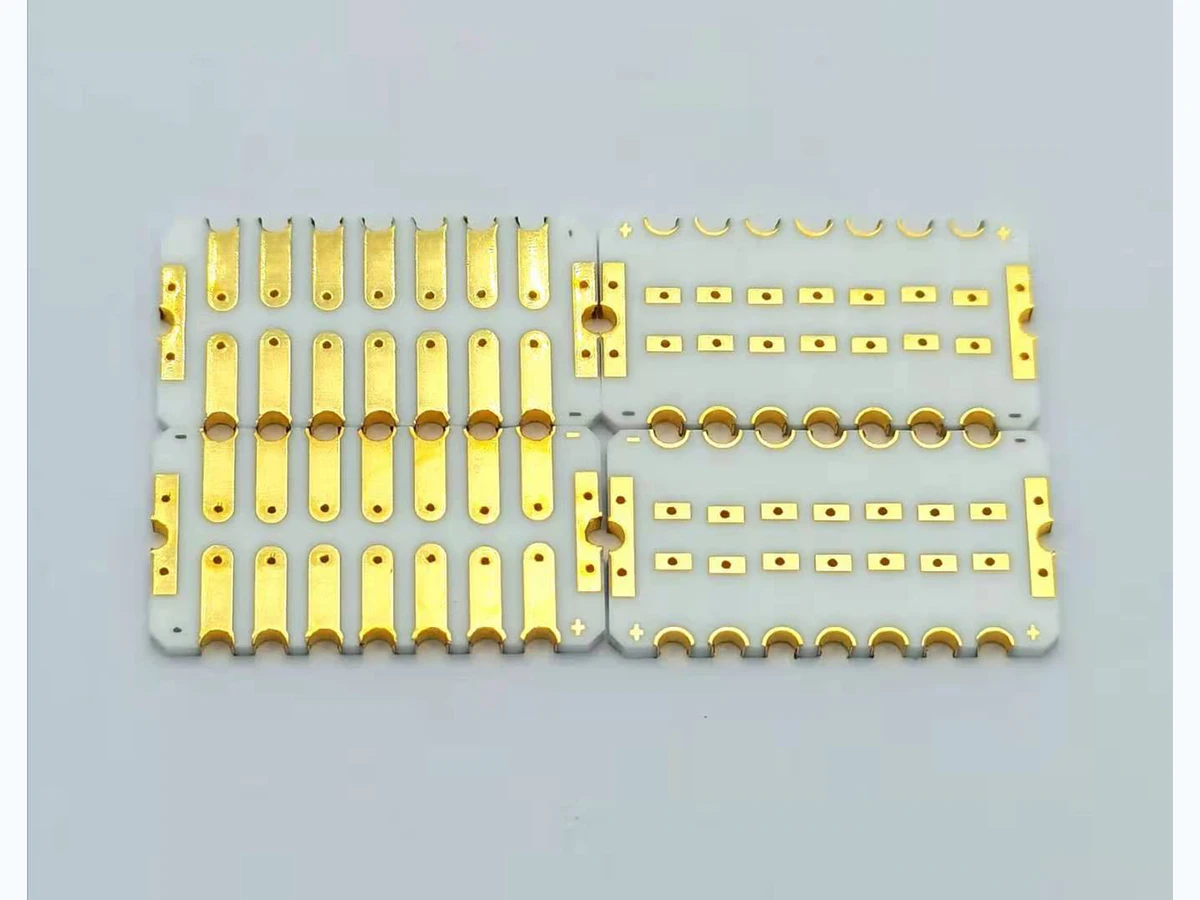
Choose Gold for a Joining System, Not Its Colour
The physical starting point is straightforward: Gold-based thick film can provide noble surfaces and wire-bond compatibility but requires compatible process and assembly materials. From there, solder interactions, diffusion and substrate adhesion remain construction-specific. For thick film conductor materials, the important issue is the amount of process margin left after normal variation is included.
On the drawing and in the review record, state wire material, bond method or solder restriction and the number of subsequent firings. Keep the requirement functional wherever possible, while making any safety- or interface-critical boundary unambiguous.
A production trial should capture bond pull or shear distributions and aged contact resistance. Record the condition of the specimen and the next operation so that a later change can be traced to a specific stage.
If the team sees excellent initial wire bonds with degradation caused by an incompatible underlying layer or heat history, pause before adding inspection or rework. First check whether the layout and the qualified process window are asking for contradictory outcomes.
Consider Mixed Metallurgy as an Interface Design
In a stable manufacturing route, a cost-effective circuit may use one conductor for routing and a specialised overprint for selected pads. This means the overlap between metallurgies becomes a critical electrical and mechanical interface. The observation is especially useful because it connects a visible feature to an electrical, thermal or mechanical consequence.
The control plan should define overlap, firing order and areas that must remain exposed. It should also name the drawing characteristic or coupon that represents the requirement, avoiding an instruction that depends on personal interpretation.
Evidence comes from interface resistance, adhesion and assembly testing on the production stack. A trend across position or lot is usually more valuable than a perfect reading from one hand-picked sample.
Investigate open or high-resistance transitions hidden beneath a visually sound pad. The pattern may identify a narrow process interaction long before the final circuit becomes an open, short or out-of-tolerance value.
A Worked Engineering Review
A ceramic sensor may need low-resistance internal routing, soldered terminals and a sliding contact region. Those three functions should not be forced into one unexamined conductor choice. Silver-rich routing may be attractive, an Ag-Pd termination may better tolerate the solder cycle, and the contact track may require a wear-qualified surface. The review maps each conductor function and then checks whether the pastes are co-fire or refire compatible. Overlap coupons and contact-resistance measurements make the mixed system measurable.
Design Review Checklist
- Map current, voltage and environmental exposure by region.
- State solder alloy, wire or contact system.
- Count all firing and assembly heat cycles.
- Define mixed-metallurgy overlaps.
- Qualify migration, leaching, adhesion or bonding as applicable.
Questions Engineers Commonly Ask
Is silver unsuitable for reliable circuits?
No. Silver performs well in many qualified constructions. Risk depends on spacing, bias, humidity, contamination, protection and joining conditions.
Does more palladium always improve Ag-Pd conductor?
No. It changes several properties and cost. The useful composition is the one qualified for the electrical and assembly requirements.
Can gold thick film be soldered?
Some constructions can, but solder compatibility must be reviewed. Gold dissolution and underlying metallurgy can affect joint reliability.
Related Engineering Resources
Closing Note
Conductor selection is a regional design decision. Match each path and pad to its electrical, environmental and joining duty, then qualify every interface created by mixed metallurgy.