
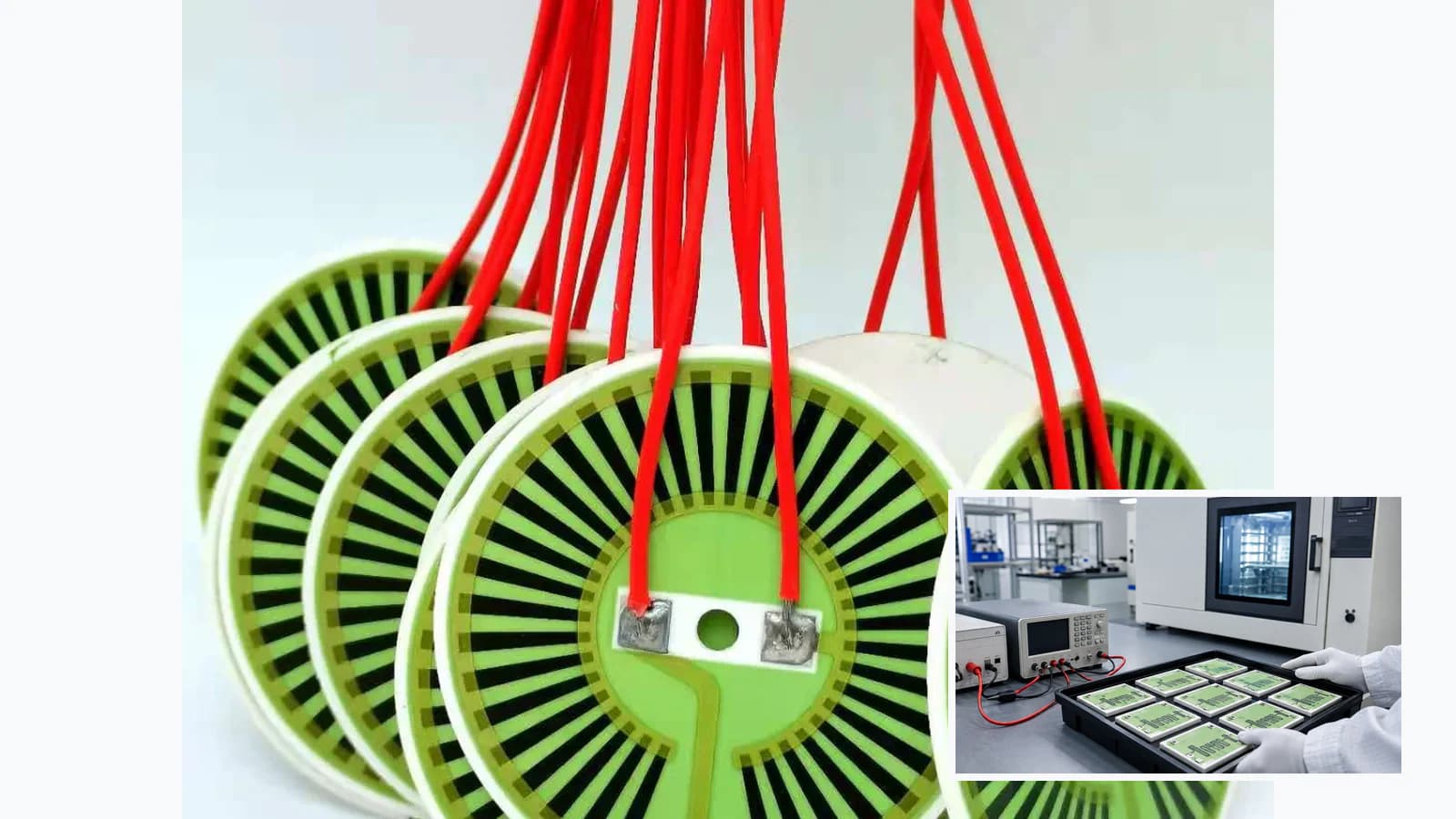
Overview
This quality method record defines Thick Film Terminal Pull-Strength Testing through purpose, specimen condition, equipment or method, sequence, acceptance logic, and traceable output. Equipment presence alone is not proof of tolerance, range, accreditation, or released capability.
Measurement route
The order makes assumptions and ownership visible before a result is promoted to a requirement.
- 01
Translate the drawing requirement
For Thick Film Terminal Pull-Strength Testing, control dimensions, datums, layer stack, interfaces, tolerances, and assembly constraints in the released drawing.
- 02
Condition and identify specimens
For Thick Film Terminal Pull-Strength Testing, document the functional requirement, operating boundary, interfaces, quantities, and acceptance owner against the current drawing.
- 03
Verify method and equipment status
For Thick Film Terminal Pull-Strength Testing, agree the inspection method, sample plan, acceptance criteria, traceability, and report format before validation.
- 04
Capture result and uncertainty
For Thick Film Terminal Pull-Strength Testing, document the functional requirement, operating boundary, interfaces, quantities, and acceptance owner against the current drawing.
- 05
Link disposition to lot and revision
For Thick Film Terminal Pull-Strength Testing, complete link disposition to lot and revision against the controlled drawing, named assumptions, responsible owner, required evidence, and release decision.
Engineering review matrix
Each row links a design variable to evidence that can support a drawing or release decision.
| Variable | Control question | Verification route |
|---|---|---|
| Measurand | For Thick Film Terminal Pull-Strength Testing, define property, feature, function, unit, datum, range, and decision the measurement supports. | Write the method so another qualified operator can reproduce it. |
| Specimen condition | Lot, processing state, cleaning, conditioning, temperature, fixturing, and destructive preparation affect results. | Record specimen condition and preparation. |
| Method and equipment | Resolution, range, status, fixture, probe, software, and operator method bound the result. | Confirm fitness for purpose and retain method/equipment identity. |
| Sampling and uncertainty | Sample size, location, repeatability, bias, guard band, and system variation influence acceptance. | Use a project sampling and decision rule instead of generic pass/fail. |
| Record and disposition | Raw result, calculated result, images, limits, exceptions, approval, and lot disposition must remain traceable. | Release a scope-qualified record linked to drawing revision and lot. |
Failure controls
These are review prompts, not evidence that every risk applies or that every test is available.
- A
Resolution or fixture influence obscuring true variation
- B
Specimen preparation changing the measured feature
- C
Acceptance without sampling, uncertainty, guard band, or decision rule
- D
Result separated from part, lot, revision, equipment, operator, or disposition
Inputs for a practical review
Unknown values may be labelled unknown. The review should convert uncertainty into an explicit decision or validation task.
Send Drawings- 01
Requirement, measurand, unit, datum, and acceptance limit
- 02
Specimen state, conditioning, preparation, and sampling
- 03
Method, fixture, equipment status, and software
- 04
Repeatability, uncertainty, guard band, and decision rule
- 05
Record, images/raw data, traceability, retention, and disposition