
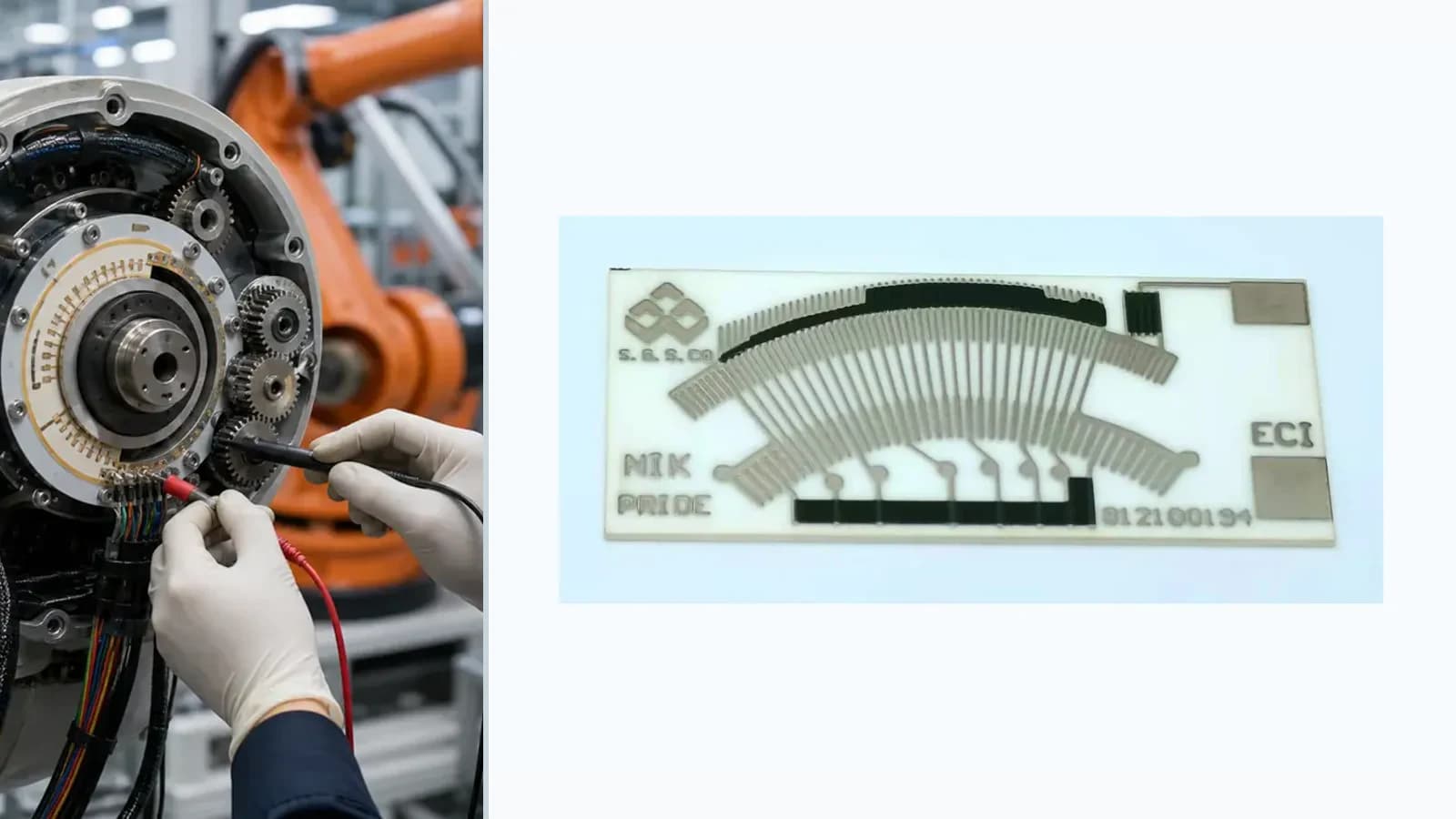
Overview
This application engineering guide maps Resistor Cards for Automation Feedback as a system-level problem. The printed element is reviewed together with mechanics, electronics, heat flow, media exposure, calibration, failure response, and final-assembly validation.
Failure controls
These are review prompts, not evidence that every risk applies or that every test is available.
- A
Curve error from linkage geometry or incorrect breakpoint placement
- B
Output noise, opens, or drift from contact wear and contamination
- C
Channel mismatch or diagnostic failure in redundant tracks
- D
Media ingress, corrosion, swelling, or protection-layer damage
Engineering review matrix
Each row links a design variable to evidence that can support a drawing or release decision.
| Variable | Control question | Verification route |
|---|---|---|
| Transfer function | For Resistor Cards for Automation Feedback, define travel or angle against resistance, ratio, voltage, curve points, endpoint behavior, and permitted error. | Measure complete forward and reverse transfer curves at controlled reference conditions. |
| Mechanical chain | Float, linkage, shaft, carrier, datum, stop, preload, and tolerance stack convert physical input into wiper position. | Correlate position with electrical output and record hysteresis and repeatability. |
| Contact interface | Wiper material, load, track finish, geometry, speed, vibration, and debris affect noise and wear. | Run contact variation, wear, interruption, and life tests with the mating contact defined. |
| Media and protection | Fuel, oil, water, additives, cleaning agents, humidity, and temperature can change track, conductor, protection, and terminals. | Expose representative assemblies under defined media, bias, temperature, time, and criteria. |
| Electronics and diagnostics | Excitation, input impedance, filtering, redundancy, plausibility, and failure detection shape usable output. | Validate channels and diagnostic states with the actual controller interface or controlled equivalent. |
System integration route
The order makes assumptions and ownership visible before a result is promoted to a requirement.
- 01
Define the system transfer function
For Resistor Cards for Automation Feedback, document the functional requirement, operating boundary, interfaces, quantities, and acceptance owner against the current drawing.
- 02
Map mechanical and electrical interfaces
For Resistor Cards for Automation Feedback, control dimensions, datums, layer stack, interfaces, tolerances, and assembly constraints in the released drawing.
- 03
Set environmental boundaries
For Resistor Cards for Automation Feedback, complete set environmental boundaries against the controlled drawing, named assumptions, responsible owner, required evidence, and release decision.
- 04
Build the validation matrix
For Resistor Cards for Automation Feedback, complete build the validation matrix against the controlled drawing, named assumptions, responsible owner, required evidence, and release decision.
- 05
Release assembly-level acceptance
For Resistor Cards for Automation Feedback, close remaining assumptions and link the quoted or released scope to the drawing revision, evidence set, owner, and change-control plan.
Inputs for a practical review
Unknown values may be labelled unknown. The review should convert uncertainty into an explicit decision or validation task.
Send Drawings- 01
Travel/angle geometry and datum scheme
- 02
Target curve table including endpoints and tolerances
- 03
Mating wiper material, load, speed, and life profile
- 04
Excitation, electronics input, diagnostics, and filtering
- 05
Media, temperature, vibration, wear, and calibration tests