
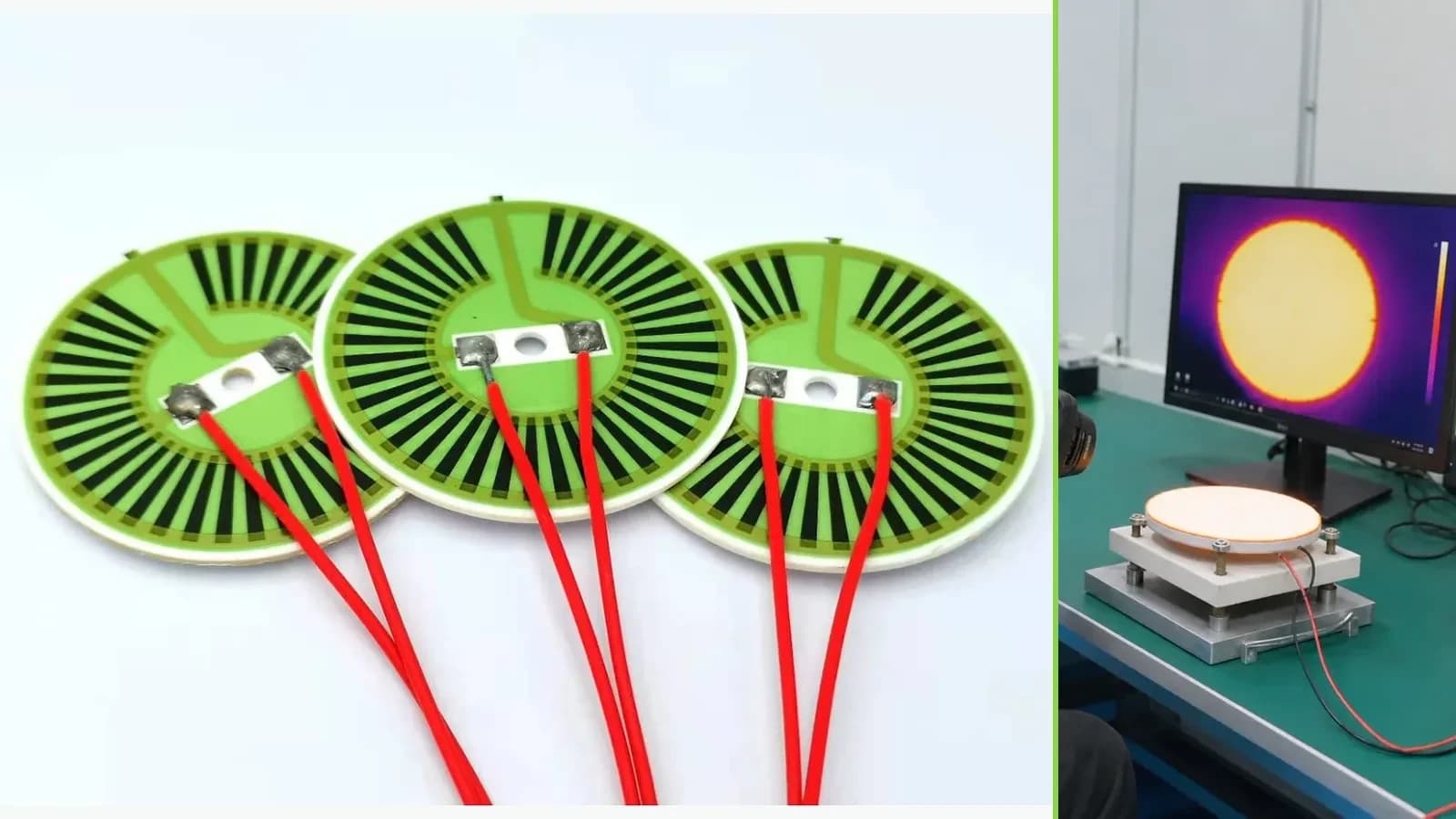
Overview
Thermal control in an analyzer can affect reagents, samples, reaction kinetics, optics, fluid handling, calibration, and reported results, but the heater is only one element in the diagnostic system. The analyzer manufacturer must define intended use, jurisdictions, IVD or other equipment classification, sample and reagent zones, disposable and reusable boundaries, temperature-dependent assay steps, contamination controls, sensor placement, control software, alarms, interlocks, user access, cleaning, service, and risk management. This guide provides component-review inputs for an indirect thermal zone; it is not a medical-device design, clinical-performance claim, sterilization claim, biocompatibility assessment, or regulatory submission. No temperature, accuracy, uniformity, cycle time, diagnostic sensitivity, specificity, safety classification, or lifetime is asserted. Representative analyzer validation and qualified regulatory review remain mandatory.
Failure controls
These are review prompts, not evidence that every risk applies or that every test is available.
- A
Presenting an analyzer heater as a medical product can falsely imply intended use, device classification, clinical evidence, or regulatory clearance that has not been established.
- B
A sensor near the heater can report an acceptable value while a reagent, sample, cartridge, optical element, or fluid path remains outside its required profile.
- C
Thermal performance demonstrated with water or an empty fixture may not represent real cartridges, reagents, viscosity, phase changes, optics, or workflow timing.
- D
Cleaning agents, spills, condensation, biohazard controls, and repeated service can affect insulation, adhesives, sensors, connectors, corrosion, and contamination pathways.
- E
A heater or controller fault can affect both safety and diagnostic validity; component testing alone cannot establish complete analyzer risk control.
- F
Changing assay chemistry, disposable geometry, load, firmware, calibration, enclosure airflow, or sensor placement can invalidate thermal and analytical evidence.
Analyzer thermal-zone review sequence
The order makes assumptions and ownership visible before a result is promoted to a requirement.
- 01
Classify intended use and jurisdiction
Identify the analyzer function, specimen and reagent handling, laboratory or near-patient use, operator, environment, jurisdictions, regulatory pathway, and whether IEC 61010-2-101 or another equipment standard is applicable. State whether the heater is isolated from fluids and users or participates in a wetted, disposable, reusable, or accessible assembly.
- 02
Map temperature-dependent process steps
List incubation, reaction, wash, drying, optical read, storage, transport, standby, cleaning, decontamination, restart, and service phases. For each, define the physical zone, sample or reagent state, timing, thermal objective, allowed gradients, process consequence, and source of acceptance criteria. Do not convert an assay requirement directly into a heater rating.
- 03
Define thermal and contamination interfaces
Show heater, carrier, spreader, vessel or cartridge, fluid path, insulation, adhesives, seals, sensors, enclosure, airflow, condensation route, spills, biohazard or chemical zones, electrical isolation, and replacement boundaries. Allocate material compatibility, cleaning, reprocessing, sterility, and contamination control to the appropriate device owners.
- 04
Separate control, monitoring, and protection
Describe primary control sensor, independent monitor where required, switching, firmware, calibration, self-test, interlocks, alarms, power limitation, safe state, data integrity, and recovery. Analyze sensor open, short, drift, detachment, stale reading, controller reset, stuck output, blocked airflow, spill, and interrupted power within the analyzer risk file.
- 05
Validate analyzer-level performance
Use representative samples, reagents, cartridges, thermal mass, heater assembly, sensors, fluidics, optics, electronics, enclosure, software, cleaning state, and environmental conditions. Correlate temperature measurements with process controls and device performance using predeclared protocols. The equipment owner determines whether clinical, analytical, electrical-safety, EMC, usability, or software evidence is required.
- 06
Maintain traceability and change control
Link heater drawings and lots to thermal-zone geometry, sensors, calibration, electronics, firmware, risk controls, verification, analyzer performance validation, labeling, manufacturing tests, deviations, complaints, and service records as applicable. Reassess evidence after changes to assay chemistry, cartridge, fluid path, materials, zone geometry, sensor, control, or software.
Engineering review matrix
Each row links a design variable to evidence that can support a drawing or release decision.
| Variable | Control question | Verification route |
|---|---|---|
| Intended use | What diagnostic or laboratory purpose, specimen, user, environment, jurisdiction, equipment class, and regulatory pathway apply? | The legal manufacturer and qualified regulatory reviewers document classification, applicable standards, exclusions, and evidence obligations. |
| Thermal process | Which sample, reagent, cartridge, surface, or air volume must follow what temperature-time profile, and why does it matter? | Use approved process and assay protocols to measure the actual zone and link deviations to defined analyzer performance checks. |
| Zone uniformity | Where can gradients arise from heater layout, spreading, mounting, fluid motion, airflow, edge loss, loading, or adjacent dissipation? | Map representative loaded assemblies at declared locations and times; a controller reading alone cannot demonstrate the zone. |
| Sensor and calibration | What sensor, location, attachment, response, self-heating, readout, calibration, uncertainty, drift monitoring, and replacement apply? | Calibrate and correlate the chain to mapped references across the use range and relevant environmental and load states. |
| Risk controls | Which thermal deviations can cause burns, electrical hazards, fluid damage, reagent degradation, invalid results, contamination, or delayed operation? | Trace hazards through risk analysis to design controls, alarms, interlocks, verification, analyzer validation, and residual-risk decisions. |
| Cleaning and spills | What reagents, samples, cleaners, disinfectants, spills, condensate, ingress, drying, and service actions can reach the zone? | The device owner validates materials, containment, cleaning, reprocessing, insulation, function, and labeling using the intended construction. |
| Software and data | How do control states, limits, self-tests, calibration data, alarms, logs, time synchronization, updates, and recovery affect thermal decisions? | Validate released software with hardware, fault cases, data integrity, user workflows, and configuration control under the device quality process. |
Reference boundary
Public method sources
These sources support the engineering method and terminology used in this technical guide. They do not establish a ThickFilmPCB material list, capability limit, customer result, certification, or finished-product specification.
- 01IEC 61010-2-101:2018 — IVD Medical Equipment Safety
Applies to equipment intended for in vitro diagnostic medical purposes and is used with IEC 61010-1. It helps classify one possible analyzer safety route; it does not establish intended use or certify any heater or analyzer.
- 02FDA Recognition — IEC 61326-2-6:2025 for IVD EMC
Records FDA recognition information for an IVD medical electrical equipment EMC standard. It supports identifying a possible EMC obligation but does not replace device-specific risk, performance, or submission evidence.
- 03FDA Guidance — Influenza IVD Performance Characteristics
Illustrates device-level performance, controls, storage-temperature, and design-validation considerations for one specific IVD context. It is not a generic heater specification and may not apply to the intended analyzer.
Inputs for a practical review
Unknown values may be labelled unknown. The review should convert uncertainty into an explicit decision or validation task.
Send Drawings- 01
Intended use, specimen and reagent types, operator, environment, jurisdictions, device classification, regulatory pathway, and applicable standards
- 02
Analyzer and thermal-zone drawings with heater, spreader, cartridge or vessel, fluid path, sensors, insulation, enclosure, airflow, spills, and access
- 03
Temperature-time objectives by process phase with locations, loads, gradients, stability, timing, recovery, and analyzer-performance consequences
- 04
Sample, reagent, cleaning, disinfectant, condensate, contamination, disposable, reusable, wetted, indirect-contact, and service boundaries
- 05
Control, monitoring, interlock, alarm, self-test, safe state, software, calibration, logging, cybersecurity or update, and recovery architecture
- 06
Electrical supply, power states, insulation, leakage, grounding, EMC, environmental, mechanical, fault, cleaning, and endurance requirements
- 07
Representative test articles, measurement uncertainty, protocols, assay controls, acceptance authority, change control, and named medical/IVD reviewers