
On this page
- Provide Controlled Geometry and Revision
- State Electrical Function and Tolerance
- Describe Assembly Interfaces
- Give Environment and Qualification Needs
- Include Volume, Schedule and Data Expectations
- A Worked Engineering Review
- Design Review Checklist
- Questions Engineers Commonly Ask
- Related Engineering Resources
- Closing Note
Prepared by Chipsimple Engineering Team, Engineering and technical content review
Published online August 10, 2026 · Reviewed August 10, 2026
ENGINEERING ARTICLE 30 / VOLUME 5
What to Put in an RFQ for a Custom Thick Film Circuit
The fastest quotation is not the one with the fewest pages; it is the one that answers the questions that change construction, tooling and test. A controlled drawing, electrical requirements, environment, assembly method, volume and evidence expectations form the core package. Sensitive details can be redacted while preserving the interfaces and tolerances needed for review.

Provide Controlled Geometry and Revision
Geometry and material meet at this point: Quotation needs one authoritative outline, layer set and dimension scheme. Therefore, conflicting PDFs, CAD and email notes create hidden assumptions. A nominal specification that omits the interface is incomplete even if every individual value looks reasonable.
During release, identify drawing number, revision, units, datums and source file precedence. Make sure the acceptance method measures the same physical feature that the design calculation assumed.
Useful confirmation includes supplier review acknowledgement and resolved question log. Keep photographs or sections tied to part, revision, lot and orientation so they remain evidence rather than decoration.
One failure signature is tooling produced from an obsolete or differently scaled file. It often becomes clear only when results are sorted by position, process stage or exposure instead of being combined into one average.
State Electrical Function and Tolerance
Process capability follows from the mechanism: Nominal values alone do not reveal power, voltage, TCR, ratio or drift needs. The direct implication is that these requirements drive paste, geometry, trim and testing. This makes the topic a design input, not merely a factory setting adjusted after the drawing is complete.
A practical release action is to list critical nets, resistor values, load, voltage and environmental limits. The requirement should survive staff changes and future lot reviews because it is recorded with the controlled construction.
Use characteristic matrix tied to drawing features to demonstrate margin. When feasible, compare the result before and after the operation most likely to disturb it.
Pay attention to a low-cost construction that cannot meet the real error budget. A corrective action is credible only when it changes that physical mechanism and the follow-up data confirm the change.
Describe Assembly Interfaces
Solder, wire bond, adhesive, spring contact and terminals require different pads. The consequence is that joining method changes metallurgy, land size and qualification. In a custom thick film circuit RFQ review, this relationship deserves an explicit decision rather than an assumption copied from a previous drawing.
The practical control is to provide alloy, wire, cure, profile and mechanical load where known. That instruction should be linked to the layer, material system or feature it governs so that production and inspection read it in the same way.
Verification should include proposed pad stack and assembly coupon plan. If the evidence is collected only after final assembly, the team loses the ability to separate printing, firing, trimming and assembly effects.
A common warning sign is redesign after prototypes reach the assembly line. Treat that symptom as a request to examine the process chain, not simply as a reason to widen the final tolerance.
Give Environment and Qualification Needs
Temperature, humidity, fuel, chemicals, cycling and high voltage affect material selection. The consequence is practical: the same circuit drawing can require different protection and evidence. This is one reason custom thick film circuit RFQ cannot be reduced to a single catalogue value.
During design review, state realistic service and test conditions with duration. The objective is not to freeze every process setting on the customer drawing, but to define the functional boundary that the manufacturer must protect.
A useful evidence package contains agreed qualification matrix and sample quantity. Comparing those records with the approved construction is more informative than judging an isolated photograph or one resistance reading.
Watch for adding generic severe tests that raise cost without representing service. It often indicates that two individually acceptable variables have combined at the edge of their windows.
Include Volume, Schedule and Data Expectations
Prototype, pilot and production quantities shape tooling and process strategy. Consequently, test coverage, fixtures and documentation have recurring and nonrecurring cost. The engineering value comes from understanding the direction and sensitivity of the effect, not from memorising a nominal number.
A robust drawing or process plan will provide order stages, annual volume, target date and required records. This makes the design intent visible and gives the supplier room to use a qualified material set without changing the function.
The result can be checked through quotation separating tooling, unit cost, lead time and deliverables. Where possible, keep readings before and after the next thermal or mechanical operation; the delta often reveals more than the final value.
The failure pattern to investigate is comparing suppliers whose quotes include different inspection scope. Before changing materials, confirm orientation, lot history, measurement method and acceptance limits.
A Worked Engineering Review
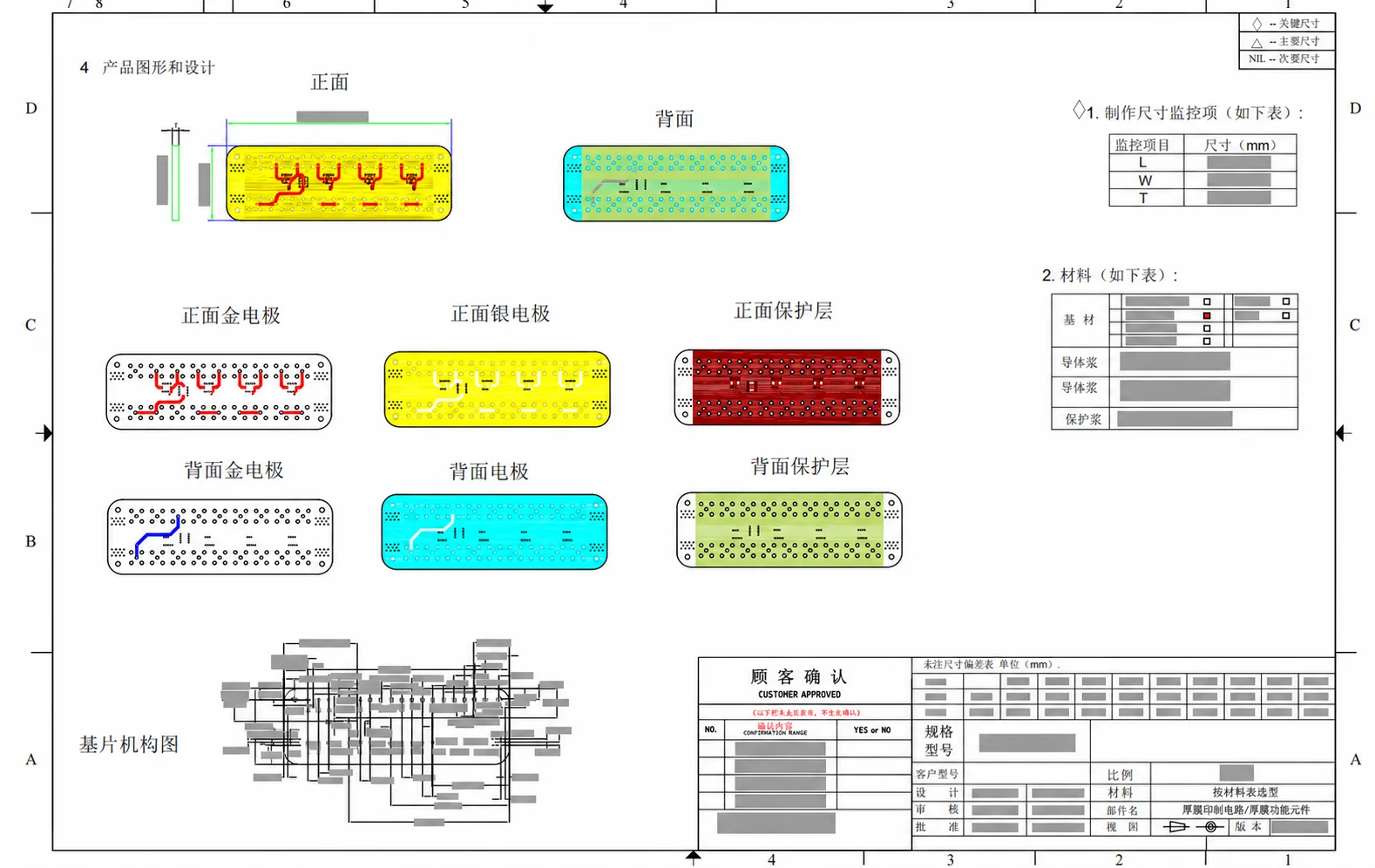
An effective package contains a dimensioned PDF, editable layer data, resistor table, stack description and a short requirements sheet. The sheet identifies substrate preference but allows an approved equivalent if thermal and dielectric limits are met. It specifies solder alloy and reflow, operating voltage, temperature cycle, key resistor tolerance and expected annual volume. The customer marks which values require serialized data and which need only certificate of conformance. The supplier returns a review with exceptions, proposed construction, tooling, lead time and qualification plan.
Design Review Checklist
- Controlled drawing, CAD and revision precedence.
- Electrical values, power, voltage, TCR and drift.
- Substrate, size, thickness and mounting.
- Joining process and pad interfaces.
- Environment, qualification, volume and records.
Questions Engineers Commonly Ask
Can the manufacturer quote from a photo?
A photo can start a discussion, but reliable quotation needs dimensions, electrical requirements and interfaces. Reverse engineering also needs sample and IP authority.
Should the RFQ specify exact paste part numbers?
Only when they are a controlled qualified requirement. Otherwise specify function and allow the manufacturer to propose its qualified system.
How can customer IP be protected?
Use NDA, redaction, controlled access and the minimum necessary system context while preserving functional requirements.
Related Engineering Resources
Closing Note
A strong RFQ reduces quotation time and future change. It tells the supplier what must function, what must fit, how the part will be assembled and what evidence will release the lot.