
On this page
A paste container can return from a print run lighter for several different reasons. Material may be on the products, on the screen, in retained samples, in segregated waste or lost through an unresolved handling event. A single issued-minus-returned figure combines all of these. A useful reconciliation states its physical boundary, accounts for the identifiable destinations and leaves any remaining difference visible until it is explained.
Key design decisions
- Compare net paste masses using consistent container and closure definitions rather than subtracting unrelated gross weights.
- Keep printed material, samples, equipment residue and segregated waste as separate destinations within the same job boundary.
- Do not label an unclosed balance evaporation, process yield or acceptable return material without additional evidence.
Define a job boundary that material cannot cross invisibly
Identify the paste grade and lot, the print job, the containers issued and the equipment included. State when the accounting interval starts and ends. A shift change is not necessarily a complete material boundary: paste may remain on a screen while another job begins, or a working container may receive an additional issue midway through the run.
Record every transfer into and out of the boundary, including top-ups, retained portions and transfer to another authorized job. Keep different grades and lots distinguishable. Combining several jars in one accounting line can conceal a material substitution or an incorrect return. The purpose is to reconstruct material movement, not merely to make the closing total match the opening stock.
Make gross and net weights comparable
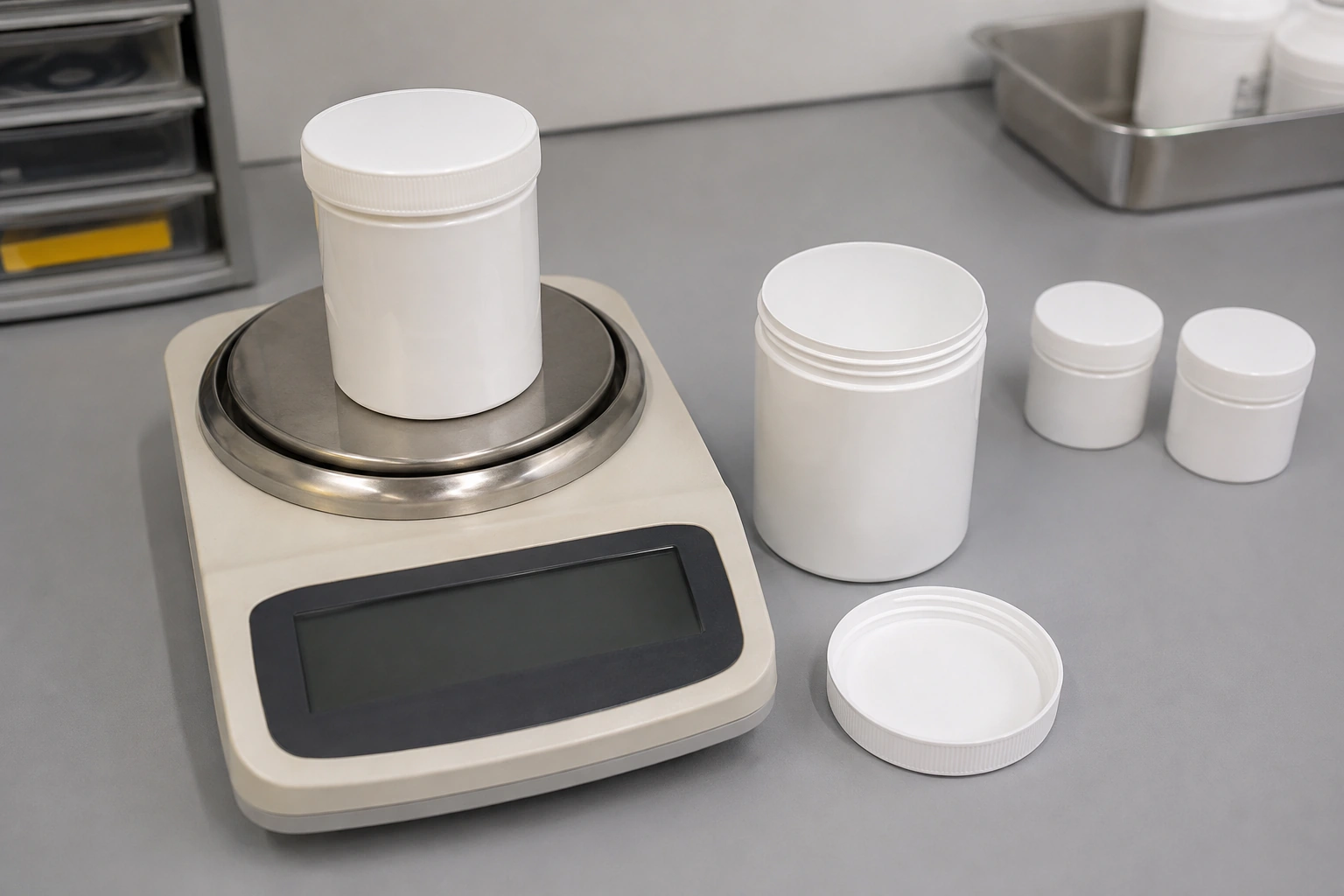
Define what belongs in the tare: container body, lid, liner and any other item that is included in the gross weighing. If an issued container is weighed with its lid but its returned counterpart is weighed without it, the apparent consumption includes a packaging difference. Use the same physical definition or record a verified correction.
Paste adhering to the lid or container wall remains paste, even if it is difficult to recover. Its location matters to use and disposition, but it should not disappear from the mass record. For a reusable working vessel, residue from a previous job also changes the starting condition. A clean tare and an identified starting paste quantity make the subtraction interpretable; an assumed empty-container weight does not.
Separate identified destinations from the residual
For a closed job-level accounting period, total issued paste should equal the sum of returned material, material deposited on product, retained samples, identified equipment residue and segregated waste, plus an unexplained residual. Define whether each term is measured directly or estimated. A return to stock and a quantity held for disposition are separate destinations even if both are physically in the same area.
The residual is a diagnostic quantity. A positive value means issued mass exceeds the identified destinations; a negative value means the destinations exceed the recorded issue. Neither sign establishes the cause. An unrecorded top-up, an incorrect tare, double-counted residue or material carried across the job boundary can produce a discrepancy without any unusual paste behavior.
m_residual = m_issued - (m_returned + m_product + m_samples + m_residue + m_waste)
- All masses use the same unit and the same defined job interval.
- m_product is deposited paste on the stated material-state basis, not automatically fired-film mass.
- m_residual is the remaining accounting difference, which can be positive or negative.
Every transfer is assigned once to the stated boundary. Deposited mass and residue estimates are clearly identified; volatile loss or an omitted transfer is not silently absorbed into another term.
Reconcile a numerical example without hiding the discrepancy
Consider a hypothetical print run with 500 grams issued. At closure, the record identifies 320 grams returned to usable stock, 34 grams deposited on products on the chosen wet-paste basis, 106 grams in equipment residue, 12 grams of segregated waste, 20 grams held separately for disposition and 2 grams retained for evaluation. The returned destination in the balance therefore totals 340 grams, of which the 20 gram hold remains unavailable to stock.
The identified destinations total 494 grams, leaving 6 grams unaccounted. Reporting 180 grams as product consumption would be incorrect because it is only issued mass minus the 320 grams returned to usable stock. It includes residue, waste, held material and samples. The 6 gram residual should remain a separate line while the transfer log, tare definitions and estimates are checked.
Do not compare wet paste directly with fired deposit mass
Printed paste changes material state through leveling, drying and firing. A fired-film mass does not equal the wet paste that formed it because organic vehicle and other constituents can be removed or transformed. A wet-mass inventory balance therefore cannot use a fired-film weight as if it were the original deposited paste quantity.
If product deposition is estimated from wet transfer, define when and how that transfer was measured and whether the sample represents the run. If another state is used, any conversion needs a validated material-specific basis. An assumed solids percentage taken from another grade can make the balance look closed while introducing a systematic error. Keep the conversion uncertainty visible and separate from the balance's directly weighed terms.
Choose the investigation from the pattern of the difference
Look for repeatable patterns before assigning a cause. A discrepancy tied to one vessel can indicate a tare or residue definition problem. A difference that changes with job duration may involve open handling, but time correlation alone does not prove evaporation. Compare the accounting method and material transfers under controlled conditions before drawing a material-performance conclusion.
| Observed pattern | Possible accounting issue | Focused check |
|---|---|---|
| Destinations exceed recorded issue | Unrecorded top-up or pre-existing vessel residue | Reconstruct every input and confirm the starting vessel condition |
| Difference approximately matches a lid or liner mass | Inconsistent gross-weight definition | Repeat the tare comparison with the same packaging components |
| Residual grows when screens are changed | Residue left outside the chosen boundary | Identify both removed and installed screen material destinations |
| Residual follows the product count estimate | Deposited-mass estimate is not representative | Measure a justified sample across the actual print run |
| Difference changes with prolonged open handling | Exposure or transfer effects remain unresolved | Use a controlled witness and matched handling history |
| Total closes but a returned grade is uncertain | Mass accounting passed while identity control failed | Keep the return segregated until material identity is resolved |
Compare closure with the uncertainty of the terms
A residual calculated from several quantities inherits their measurement and estimation uncertainty. If the terms are independent, their standard uncertainties combine by the square root of the sum of squares. Shared tare errors, repeated use of the same balance or correlated deposition estimates can require covariance treatment rather than that independent-input shortcut.
For illustration, five independent mass terms each with a standard uncertainty of 0.2 gram produce a combined standard uncertainty of approximately 0.447 gram. This does not automatically establish an acceptance band or explain a 6 gram discrepancy. Product-deposit estimates may contribute much more uncertainty than balance readings, so review the actual budget before concluding that a small residual demonstrates accurate transfer control.
Keep inventory closure separate from permission to reuse
A perfectly reconciled return can still be unsuitable for reuse if its identity, contamination state or handling history is unacceptable. Preserve the grade-specific storage, conditioning and return rules with the material disposition. Do not reset exposure history when paste moves into a newly labeled container or is combined with another permitted portion.
Close the job record with the measured and estimated destinations, residual, investigation outcome and the disposition of each returned quantity. If the method changes, retain its revision so later consumption comparisons use equivalent definitions. This creates an auditable material-use record without presenting an accounting ratio as proof of print quality, fired electrical behavior or manufacturing capability.
Provide the paste transfer and reconciliation record
Send the job boundary and material-state definitions needed to identify where the paste mass went.
- Paste grade and lot, issued and top-up records, job times and the equipment included in the accounting boundary.
- Container and closure tare definitions, gross/net weights, balance uncertainty and retained residue locations.
- Product-deposition basis, sample selection, conversion assumptions and separately tracked samples or segregated waste.
- Returned and held quantities, exposure history, grade-specific reuse rules and the unresolved mass difference.
The drawing-upload form loads as you reach this section.