
On this page
Returning unused paste is not simply the reverse of issuing it. Material that has contacted a screen, transfer tool or working container now has a history that the unopened source does not share. The remaining mass may be known precisely while its working state, contamination exposure or usable status is uncertain. A return route must keep those facts separate, particularly when several containers feed one job or recovered material is proposed for later use.
Key design decisions
- Keep supplier lot, individual container and recovered working portion as distinct identities.
- Do not use a mass-weighted average age to erase an older or unresolved exposure history.
- Determine whether reuse or combination is authorized before moving material; traceable mixing is not the same as technically permitted mixing.
Distinguish a manufacturing lot from a working portion
Two jars bearing the same supplier lot can have different opening times, temperatures, mixing events and tool contacts. The lot links their supplied origin; it does not prove equivalent condition after use. Assign a recoverable working portion its own identity that links to the source container and the job where it was exposed.
Record the amount issued without describing every residual as waste or every return as usable stock. A segregated portion awaiting assessment is still physically present, but its availability differs from approved material. Keep quantity, location and technical disposition in separate fields so an inventory total cannot authorize a print job accidentally.
Identify what contacted the recovered material
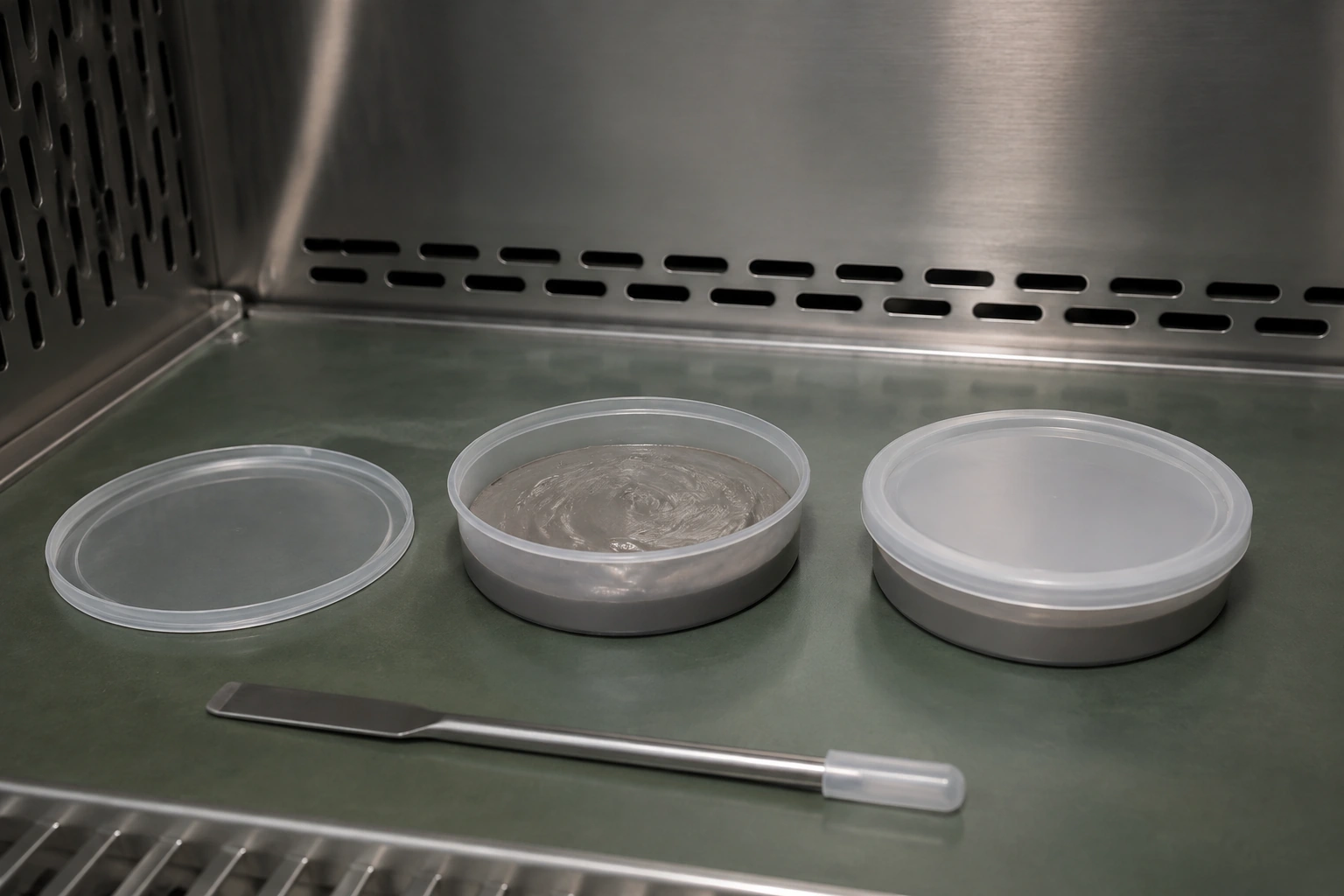
Define the recovery boundary: material remaining inside an opened source, material in a clean working pot, the paste roll on a screen and material scraped from an exposed edge are different portions. Their contacts and exposure can differ even during one uninterrupted job. A common material name is not sufficient reason to combine them.
Preserve the screen and tool identities, any replenishment events and the relevant environment. If an unapproved liquid or another paste may have contacted a portion, record that uncertainty explicitly. Returning it to a larger quantity would expand the affected population without resolving the original question. A clean-looking recovered portion is not proof that its composition and working state remain unchanged.
Make reuse permission specific to the material route
Use the current handling instructions and approved process for the named paste. Establish whether recovery is permitted, which portions may be recovered, the required container and storage state, and what verification precedes reuse. Different formulations can have different requirements; a return procedure for solder paste is not automatically a procedure for a fired conductor or resistor formulation.
Keep reuse, same-grade combination and intentional grade blending as separate authorizations. Permission to reuse a working portion does not necessarily allow adding it to unopened material. Permission to blend specified resistor-series members does not cover arbitrary recovered residues. If the material route lacks a defined decision, retain the portion separately while the responsible materials and process functions resolve it.
Show why average age is not a reuse decision
Assume a hypothetical proposed combination contains 30 g with 100 minutes of recorded open exposure and 70 g with 10 minutes. The mass-weighted average is 37 minutes. That arithmetic describes a weighted history label; it does not make the 30 g portion experience only 37 minutes or reverse any change that occurred during its longer exposure.
If a hypothetical approved rule excluded any portion exceeding 60 minutes under those exact exposure conditions, the 100-minute portion would remain outside that rule despite the 37-minute average. The assumed limit exists only to show the logic; actual rules require the named material and validated process. Nor is 100 minutes necessarily a physical equivalent age for the resulting mixture: temperature, surface area, solvent exchange and chemistry can make simple time models inappropriate.
t_mass_average = Σ(m_i t_i) / Σm_i = (30×100 + 70×10)/100 = 37 min
- m_i is the included wet mass from identified portion i, in grams in this example.
- t_i is that portion's recorded exposure duration under its defined conditions.
- The weighted result is a descriptive calculation, not a rejuvenation model or release criterion.
The masses and times are known. The expression neither models chemical aging nor establishes that the portions can be combined.
Preserve ancestry after an authorized combination
When a combination is explicitly permitted, create a new material identity linked to every contributing portion, its delivered mass and its history. Do not overwrite the oldest opening time with the combination time. Record the combining event as an additional event, leaving the constituent records available for backward review.
After the combined material enters another job, record its added exposure and the circuits it reaches. A later return remains a descendant of the original portions. Repeatedly renaming recovered material as fresh can sever the only link to an earlier abnormal event. A useful record allows both tracing one printed circuit back to its input portions and tracing one suspect portion forward to the jobs that received it.
Calculate the affected quantity after a suspect transfer
Suppose an identified 8 g suspect portion was accidentally combined with 72 g of material whose history was previously acceptable. The immediate mixture is 80 g. If 20 g is subsequently issued to one job and 15 g to another, 45 g remains. The material disposition must address all three descendants, not just the 8 g originally identified as suspect.
The quantities reconcile as 8 plus 72 equals 20 plus 15 plus 45. They do not reveal how much suspect material reached each circuit or prove homogeneous distribution. Do not use an assumed ten percent fraction to release ninety percent of the mixture. The relevant containment boundary follows shared exposure and physical ancestry until an approved investigation supports a narrower conclusion.
Choose a return action from identity and permission
The decision must be made before an irreversible transfer. Once two portions are physically mixed, separate labels cannot restore their original segregation. Check the receiving container and its current contents, not merely whether a convenient lid is available.
| Return condition | Required distinction | Next decision |
|---|---|---|
| Opened source remainder with complete history | Different from paste recovered from a used screen | Apply the source-container handling and continued-use rule |
| Identified screen portion with an approved reuse route | Quantity can be known while verification remains pending | Store under its own identity until the required reuse checks are complete |
| Several same-grade portions with different histories | Same grade is not same condition | Confirm combination permission and retain every constituent history |
| Recovered portion with missing contact or additive history | Unknown history cannot be repaired by a new label | Segregate and obtain a defined disposition |
| Suspect portion already mixed into acceptable stock | The affected boundary includes descendants of the mixture | Trace issued quantities and remaining material before narrowing containment |
Close the return record without hiding the next use
Reconcile the returned quantity with the portion that is approved, retained for assessment, sampled or rejected. Record the actual destination and accountable disposition. An empty working pot does not establish that its contents reached the approved return container; the transfer needs an identity and quantity check appropriate to the risk.
Verify the process with a practical trace challenge: choose one recovered container, identify every contributing source, reconstruct the exposure sequence, and find the jobs that received its descendants. Then check whether the physical labels and storage locations agree with that history. The outcome should be a controlled reuse decision for a defined material route, not an averaged age or a tidy stock balance standing in for technical acceptance.
Provide the paste-return and container history
Include the physical transfers and permissions needed to evaluate recovered material without losing its ancestry.
- Paste grade, supplier lot, individual source-container identities and applicable handling instructions.
- Issued and recovered portion masses, screen and tool contacts, exposure records and any additives.
- Permitted reuse or combination route, required verification and receiving-container definition.
- Mixture ancestry, subsequent job issues, remaining material locations and any unresolved transfer events.
The drawing-upload form loads as you reach this section.