
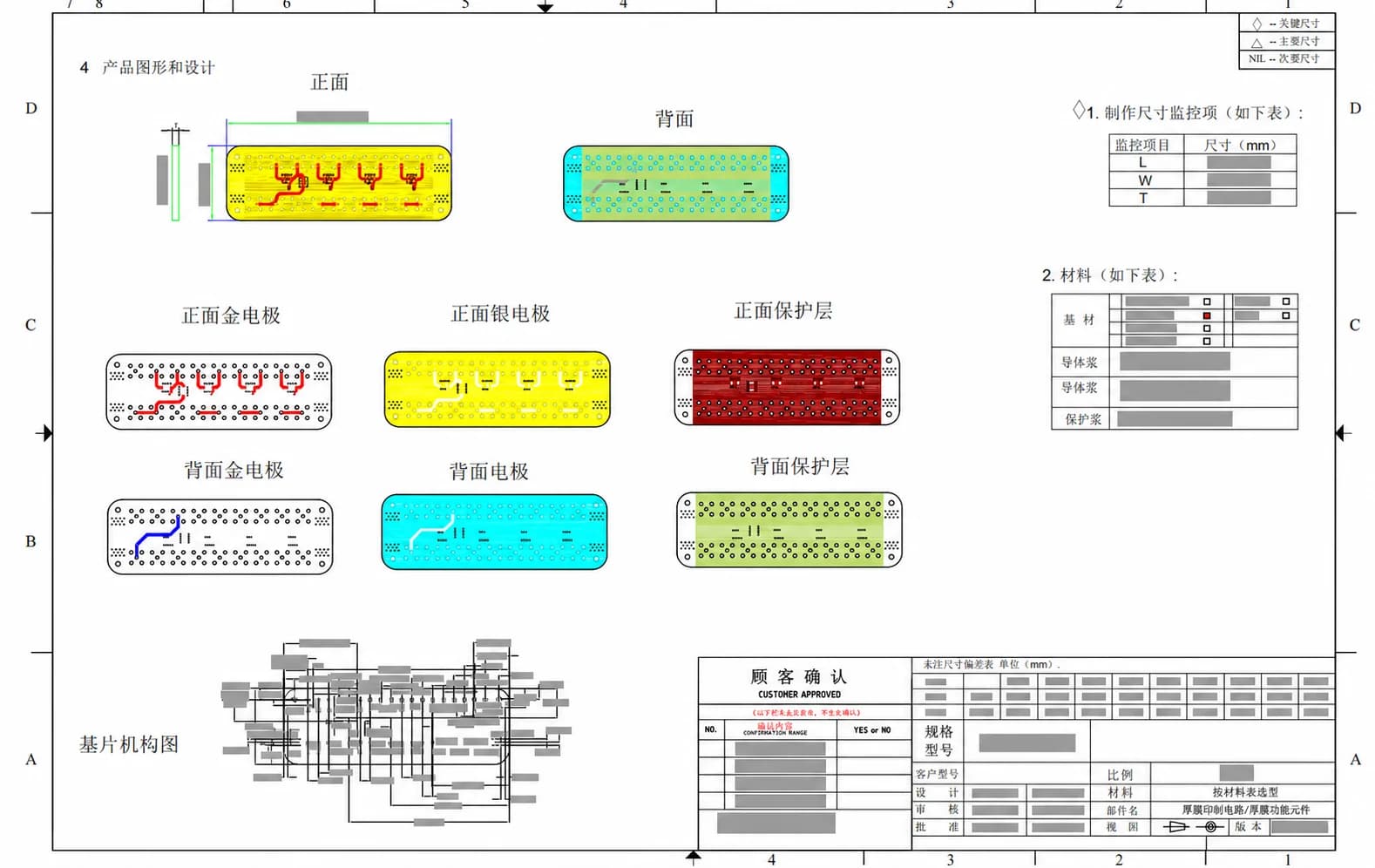
Overview
A thick-film design review is a controlled decision process that connects customer intent to a buildable, testable, evidence-bounded configuration. It is not a generic checklist completed after artwork is frozen. The review must reconcile circuit function, substrate, conductor, resistor, dielectric or protection, print/fire sequence, geometry, tolerances, thermal and mechanical interfaces, assembly, environment, inspection, validation, sourcing, and change control. Open questions must remain visible as Conditional, Unknown, or Evidence Needed; an attractive drawing, supplier data sheet, prototype reading, or passing build cannot silently become production or public capability approval.
Failure controls
These are review prompts, not evidence that every risk applies or that every test is available.
- A
Treating review as a formatting exercise after material, geometry, tooling, or public claims are already committed.
- B
Filling missing customer requirements with generic values, competitor data, supplier typicals, or assumptions from a different product family.
- C
Allowing a feasibility comment, sample result, source citation, or passing software check to become manufacturing approval or a public capability claim.
- D
Reviewing individual layers while missing coupled current, heat, stress, chemical, contact, assembly, and fault paths across interfaces.
- E
Using a test name without specimen, fixture, conditions, uncertainty, acceptance, failure mode, report, and configuration traceability.
- F
Changing material, supplier, geometry, firing, joint, mounting, firmware, load, or environment without comparing and reopening affected evidence.
Engineering review matrix
Each row links a design variable to evidence that can support a drawing or release decision.
| Variable | Control question | Verification route |
|---|---|---|
| Input configuration | Identify every drawing, data file, sample, specification, software version, material request, assembly document, quantity and revision in scope. | Use a controlled transmittal and resolve duplicate, obsolete, missing, or conflicting records before approval. |
| Requirement trace | Assign source, rationale, units, nominal/limit, condition, tolerance, owner, design response, verification, evidence and status to each requirement. | Audit bidirectional trace from requirement to drawing/model/test and from each acceptance test back to an owned requirement. |
| Material/process stack | Name substrate, conductors, resistors, dielectrics, protection, vias, trims, fires/refires, finishes, joints, cleaning and assembly heat. | Review compatibility and retain supplier/product/revision and process identity with every supporting result. |
| Models and assumptions | Document equations, units, inputs, sources, tolerance method, uncertainty, simplifications, validity range, expected failure modes and correlation plan. | Independently check calculations and compare predictions with controlled measurements before relying on margins. |
| Interfaces and environment | Define electrical nodes, source/load, heat paths, mounting, contact, leads, housing, fluids, airflow, humidity, vibration, handling, storage and faults. | Review interface-control drawings and test the production-intent boundary rather than isolated coupons alone. |
| Verification and acceptance | State method, specimen, configuration, fixture, instrument, calibration, sampling, conditions, uncertainty, decision rule, failure record and report. | Witness or audit representative records and ensure results answer the requirement without scope expansion. |
| Decision and change control | Record reviewers, date, status, conditions, actions, deviations, residual risk, release authority, baseline and re-review triggers without fabricated names. | Confirm actions are closed by evidence and changes are compared against the approved baseline before progression. |
Controlled model
Decision-gate and requirements-trace model
Use the review to connect each requirement to a design response, verification method, evidence state, owner, and decision. Arithmetic supports the review but does not replace judgment. Unknown inputs must not be filled with competitor values or previous-project assumptions.
Margin = Limit − Predicted_or_measured_worst_caseShows remaining distance to a one-direction acceptance limit when sign and state are defined.
- Units
- Same unit as the requirement
- Use boundary
- A positive arithmetic margin is meaningful only when the model, tolerances, uncertainty, boundary, and applicable failure modes are complete.
U_total = √(Σu_i²)Root-sum-square combination for independent standard uncertainty components.
- Units
- Requirement units
- Use boundary
- Use only for appropriately characterized independent components. Correlation, bias, non-normal distributions, model inadequacy, and decision rules need explicit treatment.
Decision comparison
| Decision | Route A | Route B | Verification |
|---|---|---|---|
| Architecture review versus manufacturing review | Architecture establishes function, technology family, interfaces, constraints, risks, verification ownership, and alternatives before detail lock. | Manufacturing review evaluates the released-intent artwork, materials, sequence, tooling, tolerances, inspection, sampling, traceability, and change controls. | Maintain separate decisions and evidence so feasibility comments do not masquerade as final process approval. |
| Open issue versus approved assumption | An open issue records missing information, impact, owner, due action, and blocked decision without inventing an answer. | An approved assumption states scope, source, reviewer, expiry or validation trigger, and consequence if false. | Audit the decision log against drawings, calculations, sources, test records, and signed review status before advancing the gate. |
- Review depth should follow consequence and novelty: a repeated geometry still needs change comparison, while a new material, joint, environment, safety boundary, or coupled thermal/electrical behavior requires deeper evidence.
- The reviewer should ask what observation would falsify each important assumption, where that observation will be recorded, and which change invalidates it.
Design-review gate sequence
The order makes assumptions and ownership visible before a result is promoted to a requirement.
- 01
Normalize the input package
Identify drawing and file revisions, schematic, units, datums, stack, quantities, operating states, environment, assembly, acceptance standards, samples, legacy references, confidentiality, and missing items. Resolve conflicting documents before detailed analysis.
- 02
Build requirements traceability
Give each functional, dimensional, electrical, thermal, mechanical, environmental, assembly, inspection, regulatory, documentation, and commercial interface requirement an owner, source, design response, verification method, evidence state, and open action.
- 03
Review technology and materials
Confirm the intended process family and keep fired ceramic thick film, polymer carbon ink, metal heater, thin film, DPC, DBC, AMB, HTCC/LTCC, and hybrid assembly distinct. Map substrate, every printed layer, firing/refire, protection, joining, and substitutions.
- 04
Analyze geometry and interfaces
Review effective fired dimensions, tolerances, registration, edges, holes, vias, pads, resistor/heater bodies, trim, creepage, current and heat paths, mounting, contact, terminals, housing, fluid, airflow, cleaning, and downstream assembly.
- 05
Close risks with evidence plans
For each credible failure mode, state cause, effect, prevention, detection, required calculation or test, specimen, boundary, measurement uncertainty, acceptance, owner, and status. Supplier sources support methods and material screening, never company performance by themselves.
- 06
Record decision and control change
Issue Approved, Conditional, Hold, or Rejected for the exact configuration; list actions, deviations, residual risks, verification, release gates, and required signatures. Baseline the decision package and define which design, material, supplier, process, firmware, fixture, or environment changes trigger review.
Reference boundary
Public method sources
These sources support the engineering method and terminology used in this technical guide. They do not establish a ThickFilmPCB material list, capability limit, customer result, certification, or finished-product specification.
- 01NASA Systems Engineering Handbook
Supports requirements, interfaces, technical reviews, verification, validation, decision analysis, risk and configuration-management discipline at a systems level. It does not define ChipSimple workflow or approve manufacturing.
- 02NIST Technical Note 1297 — measurement uncertainty
Supports identifying and reporting measurement uncertainty in evidence used for review decisions. It provides no design margin, acceptance criterion, or company capability.
- 03IPC official overview of J-STD-001J and IPC-A-610J
Supports keeping process/material requirements distinct from post-assembly acceptance at a high level. Detailed contractual use requires applicable licensed standards and project selection.
Inputs for a practical review
Unknown values may be labelled unknown. The review should convert uncertainty into an explicit decision or validation task.
Send Drawings- 01
Controlled drawing package, schematic, netlist/artwork, units, datums, stack, tolerances, revisions, samples, legacy references, and confidentiality restrictions.
- 02
Functional outputs, source/load, resistance/curve, voltage, current, power, thermal target, timing, control, calibration, faults, and acceptable errors.
- 03
Substrate and complete material/process sequence, approved/prohibited materials, firing/refires, trim, protection, finish, joint, cleaning, and substitutions.
- 04
Mounting, housing, interfaces, contact pressure, leads, connectors, strain relief, fluid/airflow, ambient, humidity, vibration, shock, handling, and storage.
- 05
Inspection, metrology, electrical, thermal, mechanical, environmental, lifecycle, sampling, uncertainty, acceptance, reports, and qualification ownership.
- 06
Prototype purpose, alternatives, tolerance samples, quantities, experiment plan, production assumptions, traceability, schedule constraints, and change rules.
- 07
Named decision owners and reviewers, evidence gaps, deviations, residual risks, the next decision gate, and separate authorization for production and public capability statements.