
On this page
A laboratory concentration is not yet a surface-cleanliness result. The extraction liquid, vessel, handling route and reporting area all influence how that number is interpreted. For a fired ceramic circuit, the useful question is whether the reported ion mass can be linked to the identified specimen and compared fairly with another cleaning condition. Establish that measurement chain before changing a cleaning process because one report contains a higher value.
Key design decisions
- Define the extracted specimen state and reporting area before submitting samples.
- Use the blank treatment required by the agreed analytical method, retaining original values.
- Distinguish recovery from a fortified liquid from recovery of residue on a real circuit.
- Compare ion-specific quantities under matched extraction conditions rather than ranking bare concentrations.
1. Define the surface population entering the extraction
Identify whether the specimen is a bare fired ceramic, a printed resistor circuit with open pads, or an assembled and coated unit. Those states expose different surfaces to the extraction liquid. Include cut edges, holes, handling contacts and any attached material in the laboratory request. An extraction of the whole assembly cannot automatically locate contamination on its narrow conductor gap.
If the question concerns one local region, choose an appropriate localized method with the laboratory instead of dividing a whole-board result by that region's area. Record what was physically contacted by the liquid. A region outlined on a photograph is not the extraction boundary unless the sampling arrangement actually isolates it. Preserve a companion specimen for examination before liquid exposure changes the original surface.
2. Match the blank to the actual preparation route
A solvent-only vial checks less of the preparation chain than a blank carried through the extraction vessel and handling sequence. Specify which background is being evaluated and retain the blank identity with its sample group. Apply subtraction only where the agreed method requires it; do not introduce a favorable correction after seeing the result.
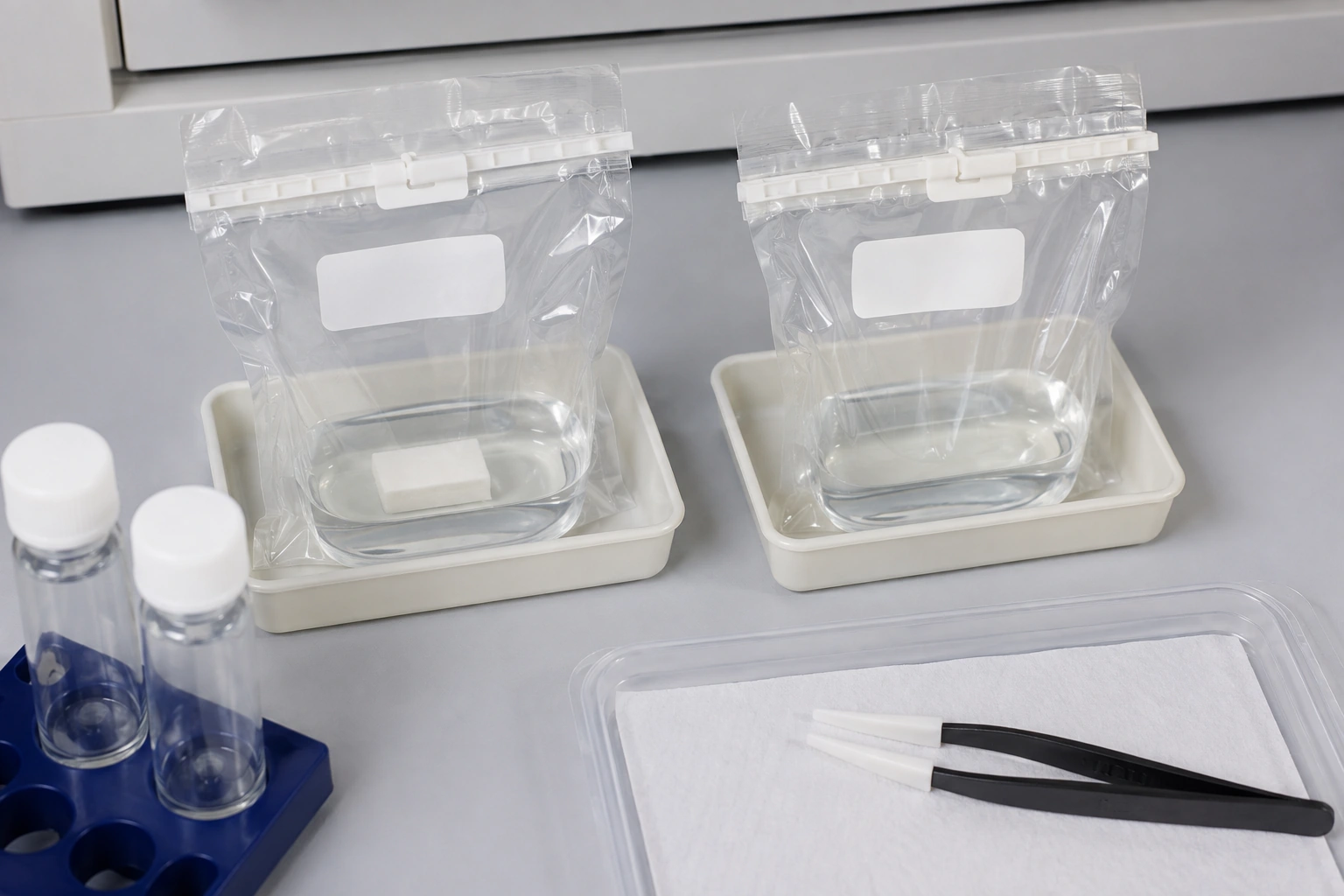
For a method using matched bag blanks, the vessel lot, liquid volume and exposure need to represent the specimen extraction. A high or unstable background makes a small specimen contribution difficult to resolve. Investigate that condition rather than treating a large subtraction as a routine way to rescue the result. Preserve the raw sample and blank concentrations alongside any corrected quantity.
3. Convert concentration to recovered mass before comparing surfaces
Use explicit mass-per-volume units in the calculation. The abbreviation ppm can conceal assumptions about solution density or the laboratory's reporting convention. Ask for the concentration in units such as µg/mL, together with any dilution factor already applied. Do not multiply a report by a dilution factor a second time.
In a hypothetical matched-volume calculation, the sample contains 0.080 µg/mL of one identified ion and its applicable blank contains 0.020 µg/mL. At a final extraction volume of 10 mL, the blank-corrected recovered mass is 0.60 µg. Dividing by an agreed 6 cm² reporting area gives 0.10 µg/cm². This arithmetic illustrates the data chain; it supplies neither a ceramic acceptance limit nor proof that extraction removed every ion.
m = (Cs − Cb) × V; q = m / A
- m: blank-corrected recovered mass of one identified ion, in µg
- Cs: specimen-extract concentration on the final dilution basis, in µg/mL
- Cb: applicable matched-blank concentration on the same basis, in µg/mL
- V: final extraction volume, in mL
- A: agreed reporting area, in cm²
- q: blank-corrected recovered mass per reporting area, in µg/cm²
The agreed method calls for blank subtraction; sample and blank use matching extraction volume and preparation conditions, and concentrations include all required dilution corrections. Recovered mass does not imply complete physical extraction or supply an acceptance limit.
4. Keep the denominator physically consistent
Specify whether the reporting convention uses the two major faces, a measured total surface or a defined local exposed region. A rectangular 20 mm by 15 mm substrate has two major faces totaling 600 mm², or 6 cm². Using only one face would halve the denominator and double the reported surface density for the same recovered mass.
Do not improve a result by adding an arbitrary component-area allowance to a populated specimen. If an assembly requires a different area convention, retain that convention and do not compare it directly with an earlier bare-substrate result. For process investigations, the recovered mass per identified circuit can be useful alongside area-normalized data because it makes changes in the denominator visible.
5. Separate dilution from actual removal
Suppose a second extraction recovers the same 0.60 µg into 20 mL instead of 10 mL. Its corrected concentration becomes 0.030 µg/mL, half the first value, while its surface result remains 0.10 µg/cm² for the same 6 cm² area. Comparing concentrations alone would falsely suggest a fifty-percent reduction.
Conversely, a lower final volume may make an ion easier to measure but can also change the physical extraction arrangement. Confirm that the liquid contacts the intended surfaces and that any modified method remains suitable. Record final volume rather than assuming that the initially dispensed liquid is unchanged after heating, transfer or evaporation. Volume accounting and extraction effectiveness are different questions.
6. Ask what the recovery experiment actually challenged
Adding a known amount of an ion to an extracted liquid challenges analysis in that liquid matrix. It does not by itself demonstrate removal of dried residue from an overglaze boundary or beneath a component. Distinguish instrument response, matrix effects and physical extraction when reviewing a laboratory's recovery statement.
For an illustrative liquid check, an unfortified aliquot measures 0.060 µg/mL. After adding an amount equivalent to 0.050 µg/mL on a consistent final-volume basis, the fortified result is 0.105 µg/mL. The recovered increment is 0.045 µg/mL, giving 90% recovery. Whether that is acceptable belongs to the selected analytical method. It is not permission to divide every circuit result by 0.90 or declare the surface extraction ninety-percent complete.
7. Resolve the measurement failure before interpreting the cleaning trial
Different weaknesses require different follow-up. Repeating the same injection may help investigate instrument repeatability but cannot recreate a missing extraction blank. Likewise, re-extracting a specimen that has already lost soluble residue is not an independent repeat of its original surface. Decide what information remains recoverable before consuming additional specimens.
| Observation | Unresolved question | Next action |
|---|---|---|
| Sample and blank are close | Can the specimen contribution be distinguished from background? | Review method uncertainty and reporting limits; retain both values |
| Lower concentration with a larger volume | Was less ion mass recovered? | Recalculate mass and the unchanged area basis |
| Liquid spike behaves poorly | Does the extract matrix affect analysis? | Ask the laboratory to investigate matrix-specific performance |
| Good liquid-spike recovery | Was residue removed from the product surface? | Review extraction suitability separately |
| Whole assembly result changes after coating | Did contamination change or did accessible surface change? | Compare matched assembly states and extraction access |
| Corrected value is negative | Is background variation larger than the detected contribution? | Use the agreed reporting rule; do not describe negative contamination |
8. Connect the verified result to a bounded process decision
Retain specimen identity, cleaning state, extraction conditions, blank results, final volume, dilution history, ion identities and area calculations together. State the laboratory's quantification limits in the same final reporting units. A not-quantified entry is not a measured zero, and a total that silently treats such entries as zero can conceal the measurement boundary.
Compare the verified results with the relevant electrical or attachment requirement using specimens that represent the actual process. Ionic analysis does not measure loose ceramic particles, prove bond strength or replace an application-specific insulation assessment. If cleaning conditions differ, keep exposure and material compatibility in the separate process review. This measurement review establishes whether the chemical evidence is usable, not whether every other circuit function has passed.
Provide the cleaning comparison and laboratory data chain
Send the sample states and unrounded analytical inputs needed to interpret the recovered residue.
- Ceramic and printed-layer identities, assembly state, cleaning conditions and specimen identifiers
- Whole-surface or localized extraction boundary with the agreed reporting-area calculation
- Laboratory method, liquid and vessel identities, exposure conditions and final volume
- Raw sample and blank concentrations, dilution factors, identified ions and reporting limits
- Fortification stage, recovery calculation and relevant method acceptance rules
- Electrical or attachment concern motivating the comparison and retained companion specimens
The drawing-upload form loads as you reach this section.