
On this page
A termination study can produce a precise-looking correction from an uninformative set of coupons. If every resistor has almost the same length, small reading errors can move the extrapolated intercept substantially. If overlap and length change together, the study cannot attribute that movement to either variable. Coupon selection should therefore precede curve fitting. The output is a drawing set that makes a specific terminal question observable, with enough length leverage, repeated geometries and accessible measurement boundaries to reveal when the chosen model is inadequate.
Key design decisions
- Choose a length span that resolves an intercept within the required uncertainty while retaining product-relevant short coupons.
- Vary overlap or terminal style independently from body length so their effects are not confounded.
- Provide separate force and sense access without moving the electrical observation boundary between variants.
Choose the terminal question before the pattern
Decide whether the study must compare conductor overlap, distinguish two terminal constructions, or determine how much a fixed termination contributes to short-resistor value. These require different coupon matrices. A simple fixed-width length ladder can describe a combined end contribution, but it cannot by itself prove which microscopic interface creates that contribution. Build additional variants only when they separate a mechanism that matters to the intended decision.
Write down what must remain unchanged: resistor material, conductor material, width, processing order and sense location are common controls. Identify any unavoidable differences, such as a different pad needed for one attachment. A terminal contribution measured through that attachment is useful only if the comparison explicitly includes it. The coupon need not resemble the whole product, but the electrically relevant transition and its thermal history must be representative.
Give the length series enough leverage
In a linear resistance-versus-length fit, the intercept lies at geometric zero, generally outside the measured range. Its uncertainty depends on how far the measured lengths extend and where they are centered. Several nearly identical lengths provide repeated readings near one point, yet provide little information about the slope. A small slope change then moves the inferred intercept even when the fitted values near the measured center barely change.
Use the expression below to compare proposed coupon sets before fabrication. It assumes length is known accurately and resistance scatter has equal variance. When dimensional uncertainty is appreciable, it is only a screening calculation; the analysis must also include uncertainty in length. The purpose is to avoid spending the available coupon area on a ladder that cannot resolve the terminal difference of interest.
SE(b) = sR sqrt[1/n + Lmean²/Σ(Li − Lmean)²]
- SE(b) is the estimated standard error of the fitted zero-length intercept in ohms.
- sR is the residual standard deviation of resistance in ohms.
- n counts individual coupon observations, including repeated lengths.
- Li and Lmean are individual and mean lengths in the same unit.
Ordinary least-squares model R = mL + b, independent equal-variance resistance errors, accurately known lengths and a valid linear relationship over the chosen domain.
Compare two six-coupon allocations
Suppose the expected resistance scatter is five ohms per observation. A compact ladder uses lengths of 1.00, 1.25 and 1.50 millimeters, each repeated twice. Its mean is 1.25 millimeters and its summed squared deviation is 0.25 square millimeter. The intercept standard error is therefore 5 sqrt[1/6 + 1.25²/0.25] = 12.67 ohms. Repetition alone has not compensated for the narrow length span.
A second hypothetical ladder repeats 1.00, 2.50 and 4.00 millimeters twice. Its mean is 2.50 millimeters and the summed squared deviation is nine square millimeters, giving 5 sqrt[1/6 + 2.50²/9] = 4.64 ohms. The wider set is more informative under the assumptions, but four-millimeter bodies must still behave like the same film system. Neither result is a confidence interval or a demonstrated measurement capability. Short-region curvature and length error can invalidate both estimates.
Separate overlap from body length
If overlap is the selected variable, build more than one length for each overlap condition. Keep the geometric length convention unchanged; otherwise extending a conductor may simultaneously shorten the stated body and alter the interface. Record the dimensions that can actually be observed after firing and any intermediate-layer measurement needed to recover an obscured edge. Each variant should answer a visible physical difference rather than a different naming convention.
Add a terminal-feed comparison only if feed direction or pad current spreading is relevant. Full-width conductor entry and a narrow side-fed pad can produce different current distributions even with identical nominal overlap. Separate these factors instead of treating terminal area as the only descriptor. The matrix should remain small enough to repeat meaningful combinations; a large collection of single, unrelated shapes provides little estimate of ordinary variability.
| Question | Useful family | Essential control |
|---|---|---|
| How much do fixed ends contribute? | Repeated lengths at constant width | Identical overlap and observation planes |
| Does overlap change the contribution? | A length ladder at each overlap | One length origin across all variants |
| Does conductor feed crowd current? | Matched full-width and side-fed terminals | Same resistor body and comparable pad sense access |
| Does the terminal contribution scale with width? | Width families with their own length ladders | Do not assume one intercept transfers between widths |
| Does attachment add the observed offset? | Before/after attachment companions | Preserved printed-terminal sense boundary |
Design sensing access into every variant
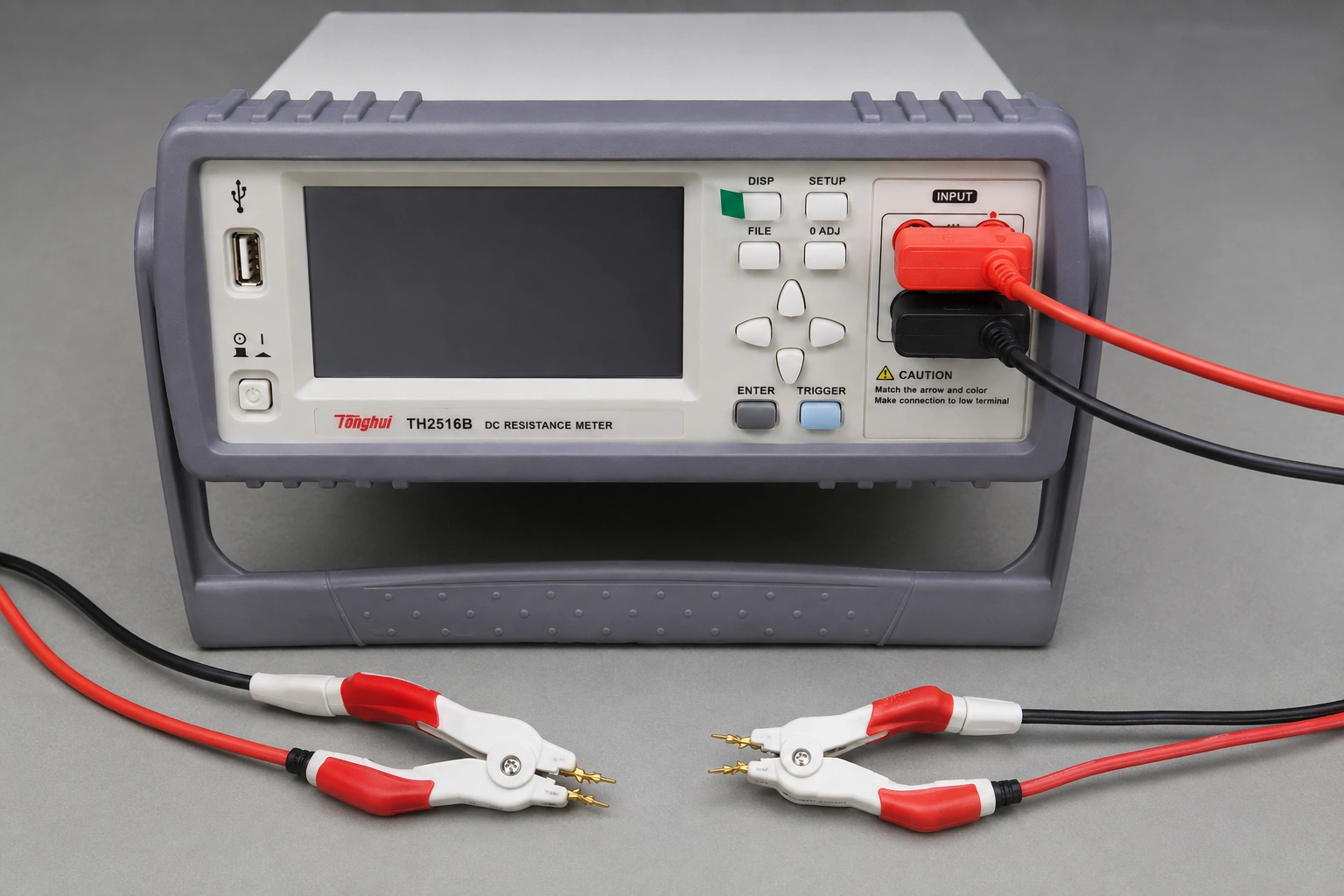
A four-wire connection removes the voltage drop in the external force leads from the observed resistance when properly arranged. It does not erase conductor resistance or transition spreading that lies between the sense points. Place those points deliberately. If they move farther from the resistor on one variant, the resulting difference may be a real conductor contribution within a different boundary rather than a changed resistor interface.
Provide probe landing areas that can be contacted repeatedly without damaging the functional overlap. Keep force current out of the sense path and document probe orientation. Where practical, add alternative sense positions to quantify the conductor segment intentionally included. This creates a check on boundary sensitivity. Avoid placing extra metal where it changes the transition being studied; an intrusive diagnostic feature can solve access while invalidating the coupon's electrical similarity.
Distribute repeats across process position
Do not place every short resistor along one substrate edge and every long resistor near the center. A position-dependent width or film change would then look like a length effect. Interleave geometries or use repeated local blocks containing the complete ladder. Preserve block identity in the data so a local process shift can be distinguished from the terminal comparison.
Measure actual length and width at the stage used for electrical testing. If the shortest coupon's length uncertainty approaches the spacing between length groups, add a better dimensional method or widen the group separation. Keep observation counts by independent coupon and processing run; repeated meter readings on one part improve knowledge of reading repeatability but do not create additional manufactured specimens. The fit must reflect the replication that actually exists.
Validate that the matrix separates the intended effects
Before fitting all data together, inspect resistance-versus-length plots within each local block and terminal variant. Use low excitation and a defined specimen temperature, then repeat selected coupons with reduced excitation to check heating sensitivity. Plot residuals against length, position and acquisition order. A useful ladder distinguishes an intercept difference from a slope change and leaves no systematic short-length trend hidden beneath a good correlation coefficient.
Challenge the design with omitted-point checks: remove the shortest group, then the longest group, and examine how strongly the inferred terminal comparison moves. Large changes relative to its uncertainty suggest dependence on a boundary group or inadequate model form. Include a product-like verification geometry that was not used to determine the fit. Predicting that observation is more informative than showing that a line passes through the coupons used to create it.
Recognize an uninformative coupon set
A fitted intercept that changes sign whenever one length is removed is a warning about leverage, curvature or an influential observation. Slopes that separate by substrate location suggest process blocking was inadequate. Differences that disappear when sense positions are exchanged point toward measurement-boundary effects. Strong curvature confined to the shortest bodies may indicate interacting end regions; adding more long coupons will not explain that local regime.
Select the final test geometries only after these checks show that the desired terminal comparison is resolvable. Deliver the ladder drawing, overlap variants, sensing coordinates, positional layout and proposed uncertainty calculation together. If the allocated area cannot support an informative experiment, narrow the question or request a dedicated coupon panel. An ambiguous intercept should not be converted into a precise artwork compensation merely because a drawing revision needs a number.
Send the termination study definition
The coupon proposal should identify the terminal difference that must become measurable.
- Terminal constructions or overlap conditions to compare, resistor stack and relevant processing history.
- Proposed lengths and widths, geometric length origin, dimensional uncertainty and available coupon area.
- Force and sense coordinates, probe access, excitation, temperature control and expected reading scatter.
- Product-like verification geometry, required resolution of the terminal contribution and independent specimen allocation.
The drawing-upload form loads as you reach this section.